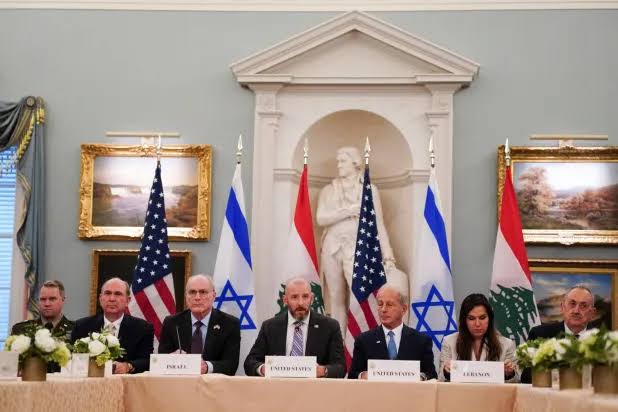
The Trump administration has brokered an unprecedented agreement between Beirut and Tel Aviv, concluding two days of marathon negotiations in Washington, D.C. Accompanied by secret guarantees and parallel channels involving Iran. This significant diplomatic achievement, reached after intense discussions in the American capital, aims to de-escalate a volatile regional situation. The deal comes amid recent violence, including Israeli strikes that killed at least four people in Lebanon, among them a motorcyclist in Maaroub, and wounded four others. A Serbian UN peacekeeper also died near Marjayoun, with two others wounded in crossfire, noting the urgent need for a cessation of hostilities.
The two parties concurred on resuming political and security discussions during the week of June 22, aiming to reach a full agreement. This commitment to ongoing dialogue shows the complex nature of the issues at stake and the necessity for sustained diplomatic engagement. US officials believe this agreement "could help remove an obstacle" in ongoing negotiations between Washington and Tehran regarding the Iranian nuclear issue, suggesting broader implications for regional stability.
Negotiations and Key Demands
Negotiators representing Lebanon were led by former ambassador Simon Karam, ambassador Nada Habadé Moawad, her deputy Wissam Boutros, and military attaché Brigadier General Olivier Hakimé. This high-level delegation was tasked with navigating the intricate diplomatic landscape. A total and genuine ceasefire was the absolute priority for the Lebanese delegation, presented as a prerequisite for any other subject, according to instructions from President of the Republic Joseph Aoun, Speaker of Parliament Nabih Berry, and Prime Minister Nawaf Salam. President Aoun described the effort as "the last chance to enter a final and full ceasefire," emphasizing the critical nature of the negotiations for Lebanon's security and stability.
On the Israeli side, ambassador Yechiel Leiter, Deputy National Security Council Director Yossi Drazin, government presidential advisor Uri Reznik, and military attaché Brigadier General Amichai Levin comprised the negotiating team. The Israeli negotiators demanded that Lebanese authorities "s’engagent immédiatement à désarmer le Hezbollah comme condition nécessaire à tout cessez-le-feu" (immediately commit to disarming Hezbollah as a necessary condition for any ceasefire). This demand noted a core Israeli security concern. Before the conflict began, Israel held five strategic points along the border, a factor that influenced their negotiating position and security considerations.
US diplomats involved in the mediation included Dan Holler, head of the State Department staff, and Jay Means, a senior official in the Near East division, providing key expertise and facilitation. The US Ambassador to Lebanon, Michel Aoun, and US Ambassador to Israel, Mike Huckabee, also participated, ensuring direct communication channels with both governments. Further White House involvement came from Michael Needham, Deputy National Security Advisor, and Secretary of State Marco Rubio, who also served as White House National Security Advisor, showing the high-level commitment from the Trump administration. The United States maintains that any agreement to cease hostilities must be concluded directly between the two governments, with American mediation, and not through a separate channel, reinforcing the official nature of the diplomatic process.
Secret Guarantees and Iran's Role
The agreement included "lateral guarantees" not formally integrated into the final text, according to sources close to the negotiations. These unwritten assurances played a significant role in securing the fragile accord. US envoy to the Middle East Steve Witkoff contacted Iranian Foreign Minister Abbas Araghchi in the hours before the ceasefire announcement, indicating a parallel channel of communication that extended beyond the direct Lebanese-Israeli talks. This engagement with Iranian officials suggests a broader diplomatic effort to address regional complexities. Additionally, officials from an unidentified Arab state held discussions with Lebanese officials, including former minister Ali Hassan Khalil and Hezbollah deputy Ammar Mousawi, through an "indirect channel" that ran parallel to the official Washington negotiations, further illustrating the multi-faceted nature of the peace efforts.
The scope of the agreement reportedly extends beyond the strict bilateral Lebanese-Israeli framework, reflecting the interconnectedness of regional security issues. Amid these developments, the United States reaffirmed its "soutien continu à la souveraineté des deux gouvernements" (continuous support for the sovereignty of both governments), emphasizing its commitment to the independence and territorial integrity of both Lebanon and Israel. However, questions remain regarding whether the "lateral guarantees" promised behind the scenes will be sufficient to uphold an agreement that neither Beirut nor Tel Aviv fully accepted. US officials maintained that "tout accord de cessation des hostilités doit être conclu directement entre les deux gouvernements, avec la médiation américaine, et non par le biais d’un canal séparé" (any agreement to cease hostilities must be concluded directly between the two governments, with American mediation, and not through a separate channel), reiterating the importance of direct engagement.
Regional fighting, separate from the Lebanon-Israel border, has threatened broader efforts to end the Iran war and to reopen the Strait of Hormuz, a critical maritime choke point. Before the conflict, approximately a fifth of the world’s oil and gas passed through the Strait of Hormuz, showing its strategic importance to global energy markets. Iran has demanded that any lasting truce extend to Lebanon, linking the regional conflicts and noting its influence in the broader Middle East. Iran has also denied responsibility for carrying out a strike on the Kuwait airport, an incident that added to regional tensions. These interconnected conflicts show the delicate balance of power and the challenges inherent in achieving lasting peace in the region.
Ceasefire Terms and Fragility
The ceasefire's implementation is conditioned on a complete cessation of Hezbollah's fire and the withdrawal of all its elements north of the Litani River. This specific demand targets the operational capabilities and geographic presence of the militant group in southern Lebanon. Both the Lebanese and Israeli governments have committed, under United States direction, to accelerate the creation of pilot zones exclusively controlled by the Lebanese armed forces, thereby excluding any non-state actors. This measure aims to establish state authority and prevent the resurgence of armed groups in the designated areas. However, Hezbollah leader Naim Kassem rejected the latest ceasefire agreement, which demands Hezbollah fighters leave southern Lebanon. Kassem described the agreement as "surrender, defeat and achieving the enemy’s goals," signaling a significant obstacle to its full implementation.
The ceasefire agreement further stipulates that Lebanon’s armed forces must take control of security zones in Lebanon from which militants would be banned. This provision is central to restoring government control and ensuring stability. Hezbollah officials have stated they will only adhere to a ceasefire if Israel halts its attacks and begins withdrawing from the country, indicating their own conditions for compliance. Kassem reiterated, "What we are concerned about is an end to the aggression, ceasefire and Israel’s withdrawal," showing the group's primary demands. The agreement also asserts that Hezbollah "is not just an enemy of Israel and an enemy of America, but that it is an enemy of Lebanon" and calls for its dismantling, a contentious point that directly challenges Hezbollah's legitimacy and role within Lebanon. Kassem maintained, "We did not make any commitment to any party to stop resisting as long as there is occupation," reinforcing Hezbollah's stance on continued resistance against Israeli presence. A significant point of fragility in the agreement is the absence of a binding timeline for the withdrawal of Israeli forces from Lebanese territory, leaving a key issue unresolved and potentially undermining the long-term viability of the ceasefire. Hezbollah explicitly demands a complete Israeli withdrawal from Lebanon, making this omission a major point of contention.
Broader Context and Reactions
Israeli forces have seized large swaths of southern Lebanon, with reports indicating that Israeli troops have taken control of approximately a fifth of the country. This territorial gain creates a complex situation for any withdrawal. According to reports, Israeli Prime Minister Benjamin Netanyahu aims to continue Israel’s offensive until Hezbollah no longer poses a threat, outlining a clear strategic objective that could prolong the conflict. Amidst the conflict, more than 3,500 people have been killed in Lebanon, and over 1.2 million individuals have been displaced, creating a severe humanitarian crisis. Airstrikes on Sohmor killed three people and wounded others, while 27 Israeli soldiers have been killed, noting the human cost of the hostilities on both sides. Hezbollah resumed rocket and drone attacks days after Israel and the United States attacked Iran on February 28, launching these attacks in solidarity with Iran, demonstrating the interconnected nature of regional conflicts. Separately, a strike on a commercial airport in Kuwait killed an Indian national and wounded more than 60 people, adding to the regional instability. Lebanese President Joseph Aoun called the new agreement "the last chance to enter a final and full ceasefire," reflecting the dire need for peace. The United States reaffirmed its "continuous support for the sovereignty of both governments" and maintained that "any agreement to cease hostilities must be concluded directly between the two governments, with American mediation, and not through a separate channel," emphasizing the diplomatic framework it seeks to uphold. The agreement's success hinges on overcoming significant hurdles, including Hezbollah's rejection of key terms and the absence of a clear Israeli withdrawal timeline, making its long-term effectiveness uncertain.