Moscow, Russia, experienced its largest aerial attack of its kind in two years on June 18, 2026, according to Russian authorities and official news agencies TASS and RIA Novosti. The scale and intensity of the assault marked a significant escalation. Russian state media described the assault as the most violent and dangerous of its type in approximately two full years, noting the unprecedented nature of the drone operation that targeted the capital region. This widespread attack showed the persistent security challenges facing Russia's most populous city and economic heartland.
Targets and Damage Assessed
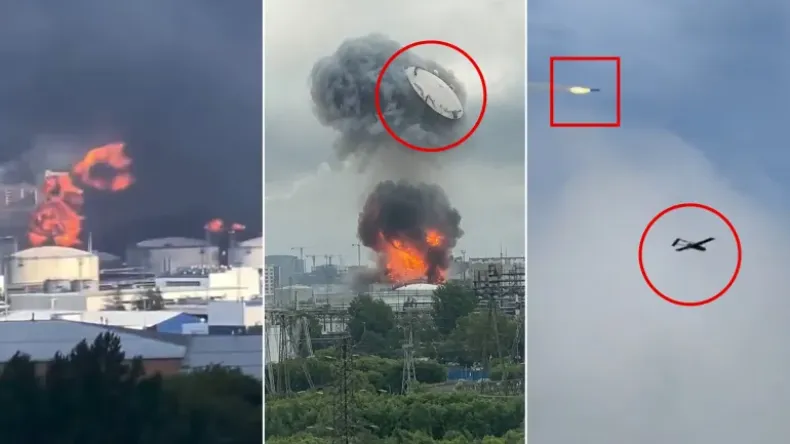
Ukrainian President Volodymyr Zelenskyy confirmed that the strikes successfully hit vital oil facilities for the second time in just one week, indicating a deliberate and sustained campaign against Russia's energy infrastructure. The 'Kaputnya' oil refinery, wholly owned by the Russian energy giant Gazprom, sustained a direct and powerful aerial strike. This particular incident marked a significant breach of Moscow's air defenses, allowing the drone to reach a critical industrial target. Moscow Mayor Sergei Sobyanin acknowledged that some drones successfully penetrated the airspace and reached the oil refinery directly, leading to immediate emergency responses. The assault also targeted vital sites belonging to the Russian army, indicating a broader strategic objective beyond just energy facilities. Additionally, oil logistics depots in the Rostov region and other areas controlled by Russian forces were hit, suggesting a coordinated effort to disrupt Russian military and logistical capabilities across multiple fronts.
Debris from the explosive drones fell on the 'Sadovod' shopping center within Moscow, but fortunately, no civilian casualties were reported at that specific location. However, the widespread nature of the attack meant that other areas were not as fortunate. Governor of Moscow Oblast Andrei Vorobyov reported a woman sustained injuries of varying severity in the Elektrostal region, located east of the capital. Her injuries were attributed to drone debris falling on her home during the attack, illustrating the potential danger posed to civilian populations even when primary targets are military or industrial. The incident in Elektrostal served as a stark reminder of the indiscriminate nature of such large-scale aerial assaults.
Air Defense and Infrastructure Impact
The sheer volume of incoming drones tested Russia's air defense capabilities. Moscow Mayor Sergei Sobyanin stated that air defense systems destroyed and shot down over 190 drones approaching the capital's airspace, a figure that shows the magnitude of the attack. Sobyanin added, "The air defense systems destroyed and shot down over one hundred and ninety drones as they approached the capital's airspace, and the Russian official acknowledged at the same time the success of some drones in penetrating the airspace and reaching the oil refinery directly, which necessitated a full alert for firefighting and civil defense teams to extinguish the raging fires." This statement provided a candid assessment of both the defensive efforts and the successful penetration by some of the attacking drones, which managed to inflict damage despite the extensive interception efforts. The activation of full alert for firefighting and civil defense teams noted the serious nature of the fires ignited at the Kaputnya refinery.
The extensive drone assault prompted severe disruptions to critical infrastructure and daily life in and around the capital. All flights were suspended at Vnukovo, Domodedovo, and Zhukovsky international airports, causing widespread travel delays and demonstrating the immediate impact on civilian air traffic. Authorities also halted traffic across significant portions of the Moscow Ring Road, a vital artery for the capital, as well as streets in Kapotnya, Verkhniye Polya, and Novoryazanskoye. These closures were implemented to ensure public safety and facilitate emergency response efforts. Additionally, Chagin Street was completely closed to both vehicular and pedestrian traffic as a direct result of the attack, further illustrating the widespread disruption caused by the drone incursions. The closures and flight suspensions noted the immediate and tangible impact of the attack on Moscow's operational capacity and logistical networks.
Strategic Significance and Escalation
Ukraine announced its full and public adoption of drone attacks targeting the Russian capital, Moscow, marking a significant shift in its declared strategy. Ukrainian President Volodymyr Zelenskyy stated that Ukrainian army forces, in close cooperation with military intelligence, carried out a precise and new targeting operation deep within the Russian capital. This declaration signaled a departure from previous ambiguities surrounding responsibility for such attacks. President Zelenskyy remarked, "The strikes succeeded in hitting vital oil facilities for the second time in just one week, leading to the ignition of fires and escalation of ongoing fires in Russia's energy facilities, considering the direction of these medium and long-range strikes as the optimal and most effective response to the systematic and deliberate Russian targeting of Ukrainian cities, towns, and infrastructure throughout the past period." The Ukrainian leader's statement directly linked the attacks to a retaliatory strategy against Russian actions, framing them as a necessary and effective response to continuous aggression. This public acknowledgment and justification of the strikes show a clear intent to project power and inflict costs deep within Russian territory, aiming to deter or disrupt further Russian military actions against Ukraine. The escalation suggests a new phase in the conflict, where strategic targets within Russia are increasingly becoming direct objectives for Ukrainian forces.