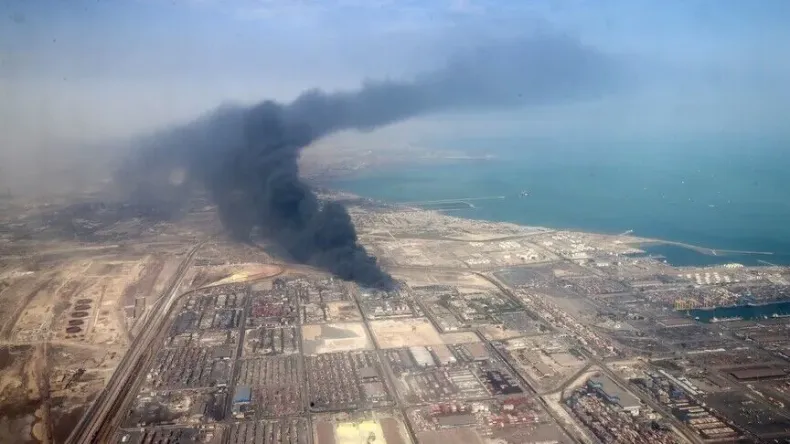
Major powers are reportedly resuming pressure tactics against emerging powers that do not align with their strategic objectives. Indeed, major powers are returning to pressuring emerging powers that reject their logic by all available means, marking a significant shift in international relations. This situation is exemplified by the ongoing conflict between the United States and Iran over the Strait of Hormuz (مضيق هرمز). The United States had initially projected a brief engagement, announcing a blitzkrieg against Iran expected to last days, then weeks, and subsequently months. A central issue is whether a superpower can achieve a rapid victory over a smaller power or a developing country, suggesting the concept of blitzkrieg and quick triumph may be obsolete. The main problem being debated in international circles is precisely whether a superpower can quickly defeat a smaller power or a developing country, challenging traditional notions of military dominance. International conflicts are anticipated to transform, potentially causing major powers to reconsider attacking smaller nations. The idea of blitzkrieg and quick victory may have effectively died, prompting a re-evaluation of military strategies. Consequently, international conflicts will witness a transformation, and major powers may hesitate to attack smaller powers, given the potential for protracted engagements and unpredictable outcomes.
The Hormuz Confrontation Unfolds
The United States and the Zionist entity initiated a large-scale assault on Iran on February 28th, utilizing advanced aircraft and missiles. The primary objective of this attack was the assassination of senior figures within the Iranian state, including the Supreme Leader. Iran, however, reportedly resisted the offensive, adapted to the situation, and mounted a response that confused the enemy, thereby avoiding defeat. Iran's ability to resist, adapt, respond, and confuse the enemy meant it was not defeated, a critical factor in the conflict's trajectory. The conflict in Hormuz, initially anticipated to be brief, now requires weeks and is escalating towards a longer engagement. The war in Hormuz now requires weeks and is heading towards becoming longer, defying initial projections of a swift resolution. This protracted conflict could potentially compel the United States to adopt a long-term war strategy, a scenario it has historically sought to avoid. The United States may be forced to adopt the long-term war option it has always avoided, a significant strategic shift. A withdrawal by the United States from this war would risk the superpower losing its international prestige. American withdrawal from the war means the superpower losing its prestige, a consequence that weighs heavily on strategic decisions. Conversely, continuing the war might lead to ground warfare, potentially resulting in significant losses for American forces. Continuing the war may lead to ground warfare with significant losses for American forces, presenting a formidable challenge to military planners.
Beyond Overwhelming Force
The ongoing conflict is reportedly trending towards a long-term engagement with an indeterminate conclusion. The war is heading towards becoming a long-term war with a difficult-to-determine end, illustrating the complexities of modern warfare. Historically, examples like the Libyan and Venezuelan cases have been cited to demonstrate the potential for swift regime changes. However, analysts suggest that victory or defeat in conflict depends primarily on internal will rather than solely on external factors. Victory or defeat in war depend primarily on internal wills before external factors, showing the psychological and societal dimensions of conflict. The ongoing Zionist aggression on Gaza, despite a significant power disparity and the reported use of genocidal tactics, has not achieved its stated objectives. The ongoing Zionist aggression on Gaza has not achieved its objectives despite the large difference in power and use of genocidal means, serving as a contemporary illustration of this principle. The Algerian people previously defeated one of the largest NATO armies through their steadfastness, will, faith, and sacrifices, illustrating the potency of internal resolve. This suggests that the power of will and internal unity can be sufficient for weaker entities to resist and ultimately prevail. The power of will and internal unity are sufficient for the weak to resist and win, offering a powerful counter-narrative to purely material-based military analysis. Therefore, the outcomes of victory and defeat are often considered to originate from within. Victory and defeat come from within, a fundamental assertion in understanding conflict outcomes.
The Ascendancy of Asymmetric Warfare
Asymmetric warfare in contemporary conflicts suggests that stronger forces face a greater possibility of defeat than weaker adversaries. Asymmetric warfare today means the possibility of the strong being defeated more than the weak, a paradigm shift in military thought. According to this perspective, a strong internal front and strong internal cohesion are prerequisites for any entity to possess effective deterrent force. Possessing a strong internal front and internal cohesion is necessary before possessing deterrent force, noting the importance of domestic resilience. The assertion is made that the United States or the Zionist entity would experience defeat from within before succumbing to external pressures, whether in Hormuz or other operational theaters. America or the Zionist entity will be defeated from within before from without in Hormuz or elsewhere, a bold prediction based on the enduring power of internal resolve and unity.