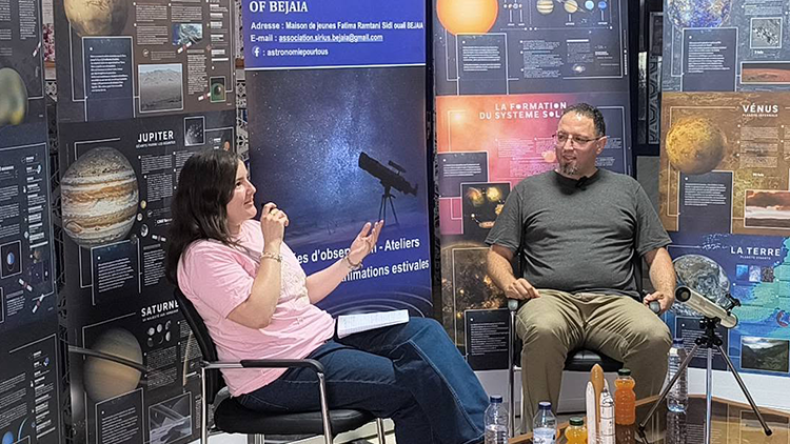
Algerian engineer Karim Bouchoucha, who works at NASA, delivered a full presentation on Saturday at the 'Sirius' association for amateur astronomers. The significant event was held at Dar El Chabab 'Fatima Ramtani' in the Sidi Wali neighborhood of Bejaia city, drawing attention to the intricate world of deep space communication. Bouchoucha, distinguished as the head of the engineering team responsible for designing and securing communications for the 'Orion' spacecraft within the ambitious 'Artemis' program, captivated the audience by discussing the profound technical complexities involved in these missions. He meticulously elaborated on the critical challenges of maintaining continuous radio and data communications with astronauts, emphasizing the immense distances involved. These vital communications must be sustained over a staggering distance exceeding 380,000 kilometers from Earth, noting the sophisticated engineering required for the success of the Artemis missions, which aim to return humanity to the Moon.
Deep Space Communication Infrastructure
To achieve such remarkable feats of communication, space agencies worldwide, including NASA, heavily rely on the sophisticated Deep Space Network (DSN). This global infrastructure comprises giant ground stations strategically distributed at 120-degree angles across the globe, located in Goldstone (California, USA), Madrid (Spain), and Canberra (Australia). This unique geographical distribution is absolutely essential for maintaining uninterrupted contact with spacecraft as the Earth rotates, ensuring that at least one station always has a line of sight to the distant probes and crewed missions. For basic communications, such as transmitting voice commands and essential telemetry data, high-frequency bands like the S-band are primarily employed. These bands provide reliable, albeit lower bandwidth, connections key for operational stability. Conversely, to manage the transmission of high-definition videos, scientific data, and other large data sets, the more advanced Ka-band is utilized. This ensures a strong and high-capacity flow of information, critical for detailed mission analysis and public engagement through visual media. A fundamental challenge in these communications is the natural signal delay, which is approximately 1.3 seconds for signals traveling between Earth and the Moon. This inherent delay is a significant factor that mission planners must meticulously account for when sending commands to spacecraft and receiving data from deep space missions like Artemis, influencing the timing of critical maneuvers and real-time decision-making.
Overcoming Signal Challenges
To effectively counter the inherent signal delay and potential interruptions in deep space communications, NASA employs advanced Delay-Tolerant Networking (DTN) protocols. These innovative protocols operate on a "store-and-forward" principle, meaning data packets are stored at intermediate nodes until a reliable connection to the next node is established, thereby ensuring data integrity and successful transmission over vast distances and during periods of intermittent connectivity. This system is key for missions where direct, continuous links are not always possible. Relay satellites positioned in lunar orbit play an absolutely critical role in maintaining continuous communication with spacecraft. These strategically placed satellites ensure that contact with the spacecraft is sustained even when the vessel is located behind the far side of the Moon, an area that would otherwise completely block direct transmission to Earth due to the Moon's mass. The precision required for these communications is critical, as Bouchoucha showed. He noted that even a single second of interference or communication loss has the potential to severely threaten the success of an entire lunar mission, emphasizing the extreme fragility and complexity of deep space operations.
Future of Space Communication
Looking ahead, the future direction for space communication is unequivocally towards revolutionary optical laser communications, according to NASA engineer Karim Bouchoucha. This advanced technology is expected to significantly enhance data transmission capabilities, offering substantially higher bandwidth and increased security compared to traditional radio frequency systems currently in use. Bouchoucha noted that optical laser communications are poised to play a key, transformative role in supporting more complex and data-intensive missions, such as those planned under the Artemis program and beyond. The anticipated shift to laser-based systems aims to overcome inherent limitations of current radio technologies, allowing for faster, more efficient, and more voluminous communication over vast interstellar distances. This development represents a key area of research and implementation for future deep space exploration efforts, promising to unlock new possibilities for scientific discovery and human exploration. The ability to transmit larger quantities of data at higher speeds will be indispensable for future lunar bases, Mars missions, and sophisticated scientific instruments that generate immense amounts of information.
Local Scientific Engagement
The event also saw the participation of Shaimaa Amin Khoja, a distinguished researcher specializing in astrophysics and a prominent science communicator. Khoja currently heads the astrophysics community at the Organization of Algerian Women Scientists (ALWIS), showcasing her commitment to fostering scientific advancement among women. Additionally, she is an active member of the 'Sirius' association, which is based in Constantine, further illustrating her dedication to promoting astronomy and scientific literacy within the broader Algerian community. Her presence showed the local scientific community's keen interest in NASA's ambitious Artemis program and the advanced communication technologies that make such deep space exploration possible.