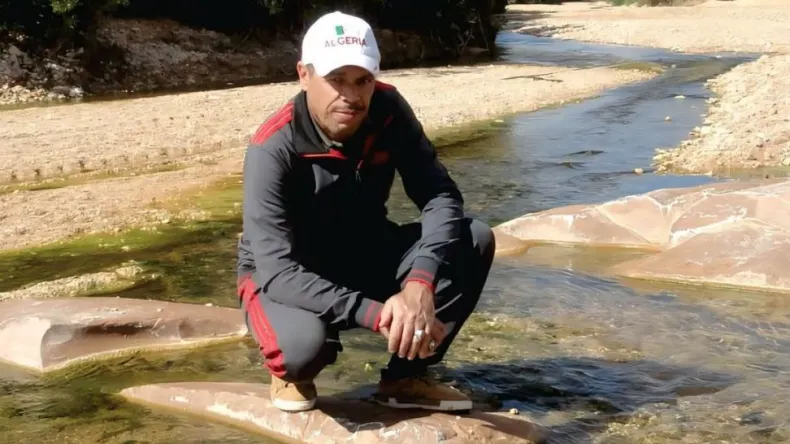
Amara Mchelfakh has initiated an exploration of mountainous terrain across the southern region of Messaad, documenting the geography of Salmanah, Messaad, Amoura, and Daldoul. The survey aims to catalog specific botanical and environmental features found within these remote areas. By systematically traversing these distinct locations, the project seeks to establish a full geographical record of the southern landscape. Amara Mchelfakh is documenting the terrain of Salmanah, Messaad, Amoura, and Daldoul to better understand the distribution of plant life across the varying elevations of the southern region.
Field observations in the region of Deir al-Nakhl identify a population of dwarf palm trees. These plants reach a maximum height of 1.2 meters. The presence of these specimens in Deir al-Nakhl provides a focal point for the broader environmental survey being conducted by Amara Mchelfakh. The specific growth patterns of these dwarf palm trees, which are limited to a maximum height of 1.2 meters, indicate unique environmental conditions within the Deir al-Nakhl area. Researchers are currently analyzing the soil composition and the specific microclimates that allow these plants to thrive at such restricted heights.
Local accounts from residents in Deir al-Nakhl suggest that the fruit produced by these dwarf palm trees possesses health benefits and lacks a pit. These reports regarding the nutritional properties and physical characteristics of the fruit require independent scientific verification to confirm the anecdotal claims. While residents of Deir al-Nakhl have long utilized the fruit, the lack of a pit remains a notable physical characteristic that distinguishes this specific variety from other known palm species in the southern region of Messaad.
The process of documenting these findings involves detailed recording of the fruit's physical attributes as observed by the local population. Amara Mchelfakh is gathering these accounts as part of the wider environmental study, ensuring that all anecdotal data is clearly distinguished from verified botanical findings. Because the claims regarding health benefits and the absence of a pit have not yet been subjected to laboratory testing, they remain categorized as local observations.
The survey conducted by Amara Mchelfakh continues to focus on the intersection of human knowledge and environmental reality. By cataloging the geography of Salmanah, Messaad, Amoura, and Daldoul, the project aims to create a reliable database for future researchers. The specific data gathered in Deir al-Nakhl regarding the dwarf palm trees serves as a primary case study for the region. As the exploration progresses through the southern reaches of Messaad, the team maintains a rigorous standard for recording environmental data. The objective remains to bridge the gap between traditional local knowledge and formal scientific documentation, particularly concerning the unique fruit found within the dwarf palm population of Deir al-Nakhl. The ongoing survey is expected to provide a clearer picture of the biodiversity present in these remote mountainous areas.