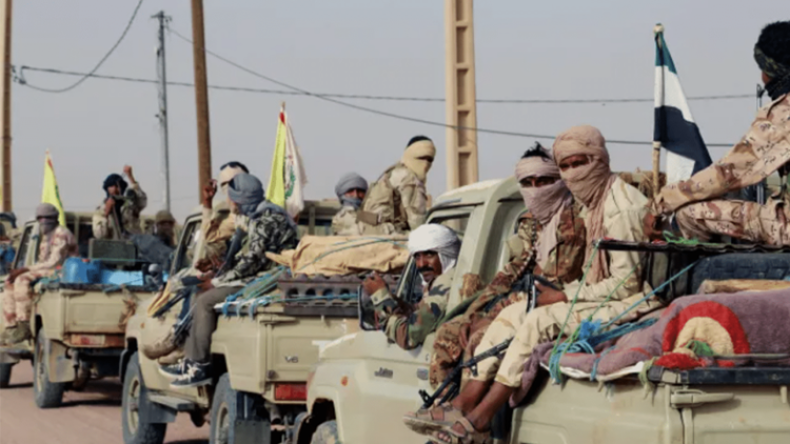
Mali’s Defence Minister, General Sadio Camara, was killed over the weekend after assailants targeted his house with a car bomb, and he later died in a hospital from his injuries. A government spokesperson, Issa Ousmane Coulibaly, confirmed the death in a statement on Sunday, following recent rapid developments affecting the Malian military junta. These developments have significantly impacted the Malian military junta, drawing international attention to the escalating security crisis. Reports indicated that Camara’s second wife and two of his grandchildren were also killed in the attack on his home, noting the brutal nature of the assault. The weekend assault was coordinated by fighters from the al-Qaeda-linked Jama’at Nusrat al-Islam wal-Muslimin (JNIM) and Tuareg fighters from the Azawad Liberation Front (FLA), groups known for their involvement in regional instability. The death of General Sadio Camara marks a critical moment for the nation, given his prominent role within the military leadership.
Assassination and Coordinated Attacks
Security breaches culminating in the assassination of General Sadio Camara, the strongman of the regime and Mali's Minister of Defense, were part of a series of sweeping attacks by jihadists and separatist rebels. These sweeping attacks by jihadists and separatist rebels seized several towns and military bases in Mali, occurring during coordinated attacks on military sites nationwide. The scale of these coordinated assaults shows the severe challenges facing the Malian government. The attack on General Camara's residence occurred on Saturday in the garrison town of Kati, located approximately 15km (9 miles) northwest of the capital, Bamako. This strategic location, close to the capital, further emphasizes the audacity and planning behind the attack. Attackers carried out a suicide car bomb assault on his home, a method indicative of the high level of threat posed by the assailants.
The attackers utilized car bombs and armed drones in their assaults, targeting Kati, the eastern city of Gao, and the central towns of Mopti and Sévaré. These simultaneous attacks across multiple key locations demonstrate a sophisticated and widespread campaign against Malian authorities. Reports indicated heavy gunfire and explosions were heard near Modibo Keita international airport and the main military base at Kati, causing widespread alarm. The Modibo Keita international airport was temporarily closed following these incidents, disrupting air travel and further noting the severity of the security situation. Gunmen also attacked several other locations across Mali, including Bamako, Gao, Kidal, and Sevare, indicating a broad and coordinated offensive. Interim President Assimi Goita also lives in Kati, the town where General Camara's residence was targeted, raising concerns about the security of other high-ranking officials. The military intelligence chief Modibo Koné was reportedly also killed during these widespread attacks, further depleting the ranks of the Malian military leadership.
Geopolitical Undercurrents and Alliances
Colonel Assimi Goïta reportedly shifted Mali's alignment towards the Moroccan axis, a significant reorientation of the country's foreign policy. This shift has been noted as a departure from traditional alliances and reflects a strategic pivot in the region. He was subsequently promoted to the rank of General, the highest rank in the history of the Malian military, a move that consolidated his power within the junta. This development occurred more than six years after Goïta's pledges to secure the country and conduct elections, promises that have yet to be fully realized amidst ongoing instability. In a related diplomatic move, Mali withdrew its recognition of the Sahrawi Arab Republic, aligning its stance more closely with Morocco's position on the Western Sahara dispute. Meanwhile, Algeria has sought to consolidate the Agreement on Peace and Reconciliation of 2015, an ongoing effort to stabilize the region and resolve long-standing conflicts.
Amidst these shifts, forces from the Kremlin-run Africa Corps paramilitary group, which had been supporting the military-led government, withdrew from a key city. Russia's Africa Corps confirmed it had also departed Kidal, a strategically important town in northern Mali. In a statement, Africa Corps indicated, "In accordance with a joint decision by the leadership of the Republic of Mali, units of the African Corps that were stationed and engaged in combat in the town of Kidal have withdrawn from the area alongside Malian Army personnel." This withdrawal marks a significant change in the security landscape, potentially leaving a vacuum in areas previously secured by the paramilitary group. An Mi-8AMTSh helicopter belonging to Africa Corps was reportedly shot down by a surface-to-air missile near Gao, resulting in the deaths of everyone onboard, showing the dangers faced by forces operating in the conflict zone. This incident notes the advanced weaponry now being utilized by insurgent groups.
Mali, alongside Burkina Faso and Niger, split from Ecowas to form the parallel Alliance of Sahel States (AES) in 2025. This move represents a major realignment of regional power dynamics and a rejection of the traditional regional bloc. This geopolitical reorientation also brought historical events into focus, including the liquidation of General Mohamed Medbouh and his group in the Skhirat coup in 1971, drawing parallels to past periods of political upheaval. General Mohamed Oufkir was involved in the 1972 coup, which included an attack on King Hassan II's plane, further illustrating a history of military interventions and political assassinations in the broader region. These historical references serve as a reminder of the fragility of political stability in the Sahel.
Internal Strife and Regional Instability
Minister of Defense General Sadio Camara and a group of his army comrades had previously demanded that President Assimi Goïta step down, indicating deep divisions within the military leadership. This internal dissent notes the complex political landscape within the Malian junta. The 2020 coup in Mali saw Sadio Camara and Modibo Koné as lead actors in the ousting of Ibrahim Boubacar Keïta’s civilian government, a key moment that ushered in military rule. Another coup in May 2021 then led to Assimi Goïta becoming the head of the junta and the denouncement of an existing peace deal between the government and rebels, further exacerbating tensions and undermining efforts towards reconciliation. This series of coups has created a climate of political uncertainty and instability.
Several cities have fallen amidst the ongoing instability, most importantly Kidal, a key strategic location in the north. Videos circulating on social media showed jihadists at the residence of the governor of Kidal, an alarming visual testament to the extent of insurgent control. These images have fueled concerns about the government's ability to maintain territorial integrity. Meanwhile, Malian forces have asserted that they neutralised more than 200 terrorists across the country and recovered ammunition, showcasing their efforts to combat the insurgency. Despite these operations, an estimated 5 million people in Mali were reported to be in need of humanitarian aid, a stark indicator of the human cost of the protracted conflict. The situation also brings to mind historical events of political purges, such as General Ahmed Dlimi, who was dealt with in 1983, suggesting a recurring pattern of internal power struggles and eliminations within military and political circles in the region.
International Condemnation and Response
International bodies including the African Union, the Organisation of Islamic Cooperation (OIC), and the United States Bureau of African Affairs condemned the recent attacks in Mali. These condemnations reflect widespread international concern over the deteriorating security situation. The European Union also issued a condemnation, adding to the chorus of international disapproval. The Economic Community of West African States (Ecowas) released a statement on Sunday, calling for "all states, security forces, regional mechanisms and populations of west Africa to unite and mobilise in a coordinated effort" against the insurgency. This call for unity shows the regional threat posed by the escalating violence. Separately, Colonel Assimi Goïta, the current leader, has received special forces training in both France and the United States, indicating a background of engagement with Western military powers despite recent geopolitical shifts. The town of Kidal, a key location in the conflict, is situated approximately 250 miles (400km) south of the Algerian border, making its control vital for regional security and cross-border stability. The international community continues to monitor the situation closely, with many nations urging a return to constitutional order and stability in Mali.