A fragile ceasefire between Lebanon and Israel saw uneven adherence this week, marked by Israeli troop movements, continued attacks, and diplomatic efforts to solidify a broader agreement. Israeli forces began their first redeployment from Debbine towards Khiam on Thursday, according to reports from the ground. This initial movement was part of a broader repositioning effort. Concurrently, Israel continued its attacks in southern Lebanon on Tuesday, while the Israeli military reported intercepting two projectiles fired into northern Israel following a ceasefire announcement. Hezbollah, for its part, stated it had attacked Israeli forces in southern Lebanon.
Diplomatic efforts continued in Washington, where a joint communiqué involving the United States, Lebanon, and Israel emerged from discussions held on June 2 and 3, 2026. This communiqué is a significant development in the ongoing efforts to de-escalate tensions in the region. Lebanon's embassy in Washington released a statement indicating that under a proposed arrangement, Israel would not launch a broad offensive on Beirut in exchange for Hezbollah refraining from attacks against Israel, thereby creating an opportunity to expand the ceasefire framework across all Lebanese territory. However, the joint communiqué, while outlining precise conditions for Hezbollah and placing the Lebanese army at the center of proposed pilot zones, notably did not formulate any equivalent Israeli obligations. It lacked a timeline for withdrawal, a sequence for verification, or guarantees regarding the return of displaced persons.
Former US President Donald Trump stated on Truth Social that he had spoken with Israeli Prime Minister Benjamin Netanyahu and representatives of Hezbollah's leaders. Trump wrote, "They agreed to stop shooting at Israel, and its soldiers. Likewise, Israel agreed to stop shooting at them." This statement came amidst reports of ongoing hostilities. Following the ceasefire announcement, the Israeli military confirmed it had intercepted two projectiles fired into northern Israel, indicating continued, albeit fragmented, adherence to the truce. Prime Minister Netanyahu also affirmed the Israeli military would "continue to operate as planned in southern Lebanon." He had previously put out a statement saying he had told Trump that "if Hezbollah does not stop firing at our cities and citizens, Israel will strike terrorist targets in Beirut." However, US news outlet Axios cited two US officials who reported that Trump later "lashed out at" Netanyahu in "an expletive-laden call," instructing him not to proceed with his plan. Opposition leader Yair Lapid criticized the situation, stating Israel had become a "client state in full." Further negotiations between Israeli and Lebanese diplomats are scheduled for Tuesday and Wednesday in Washington, aiming to build upon the initial diplomatic groundwork.
Continued Hostilities on the Ground
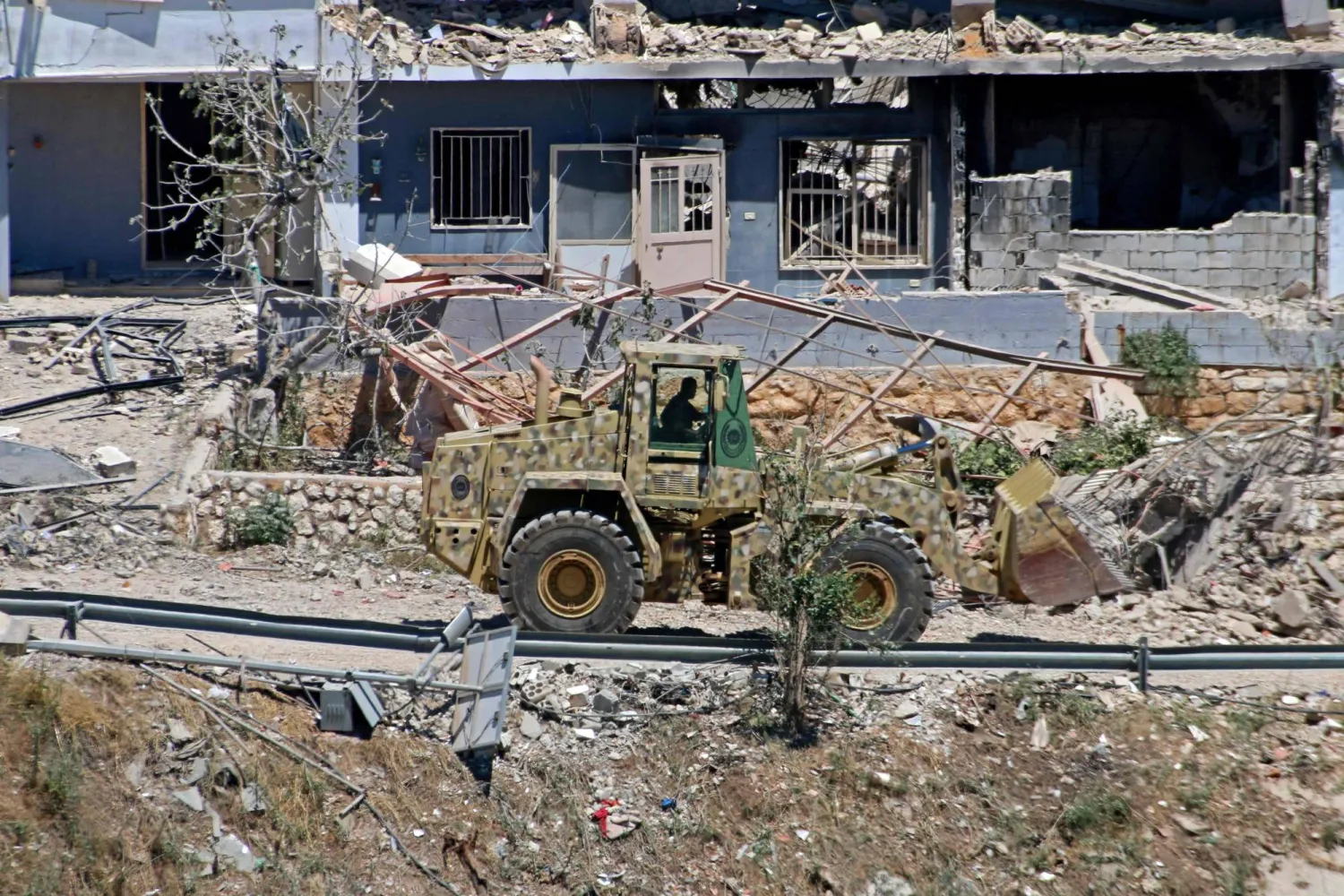
Despite diplomatic overtures, the situation on the ground remained volatile. Lebanese army vehicles, including a bulldozer, were observed moving towards Khiam, according to reports. Concurrently, Israeli forces reportedly encountered significant logistical issues during their deployment around Khiam, complicating their operations. Reports also indicated that Israeli forces carried out extensive destruction operations in Debbine, specifically affecting the Arid and Château neighborhoods, raising concerns about infrastructure damage in the area. Lebanese Prime Minister Nawaf Salam announced on Thursday that the Lebanese army would begin deploying "in pilot areas" in the south of the country, describing it as a "«première étape concrète et tangible» qui «ne porte pas préjudice au droit du Liban à un retrait israélien total»" (a "first concrete and tangible step" that "does not prejudice Lebanon's right to a total Israeli withdrawal").
The spokesperson for the Israeli army, Avichay Adraee, issued an urgent warning to residents of South Lebanon, instructing them to "«s’abstenir de se rendre dans les zones situées au sud du fleuve Zahrani»" (refrain from going to areas south of the Zahrani river). Meanwhile, Israel's Channel 12 reported that sirens sounded three times in Shlomi, Western Galilee, indicating a suspected drone attack from Lebanon, showing the persistent threat. Israeli aircraft reportedly struck the locality of Qalya in Western Bekaa and also hit the entrance of the village of Sahmar three times, demonstrating continued aerial operations.
Further incidents included an Israeli drone targeting a motorcycle in Maaroub, resulting in one fatality and one injury. Simultaneously, a drone strike hit the same location in Sahmar, killing one person and injuring four others, noting the precision and lethality of these strikes. Reports detailed that dozens of southern localities were targeted, including Meyfadoun, Kfartebbnit, Nabatiyé el-Fawqa, Kafra, Zoutar, Shawakine, Harouf, Deir Zahrani, Mansouri, Braachit, Yaroun, Yohmor el-Chaqif, and several road axes in the Nabatiyé district. These widespread strikes indicate a broad operational scope. Artillery fire also struck Arnoun, Zoutar, Meyfadoun, and Hanié, adding to the destruction. A civilian car on the Zafta–Nomiryé road was hit, injuring three members of the same family: Antoun Bou Abssi, his wife Thérèse, and their daughter Najat. Additionally, a dentist from the nearby village of Qlayaa was killed along with his son and daughter in a drone strike on the road between Marjayoun and Nabatieh, illustrating the tragic civilian toll of the conflict.
Hezbollah's Response and Claims
Hezbollah’s military wing claimed responsibility for targeting Israeli tanks and troops in the southern Lebanese towns of Haddatha, Bayada, and Zawtar al-Sharqiya, employing drones, missiles, and shells. The group also stated it had targeted gatherings of Israeli soldiers and armored vehicles near Yohmor el-Chaqif, indicating a focus on military installations and personnel. Hezbollah further announced the interception of an Israeli Hermes 450 drone and claimed the use of kamikaze drones against an Israeli command post near the citadel, showcasing their varied arsenal and tactics. In response to these actions, the Israeli foreign ministry stated that Hezbollah had violated Monday's declarations by launching "multiple missile and drone attacks from Lebanon against Israeli communities," challenging the premise of a ceasefire.
Hezbollah lawmaker Hassan Fadlallah informed the group's Al-Manar TV that it "would not support a 'one-sided' ceasefire," emphasizing the need for reciprocal commitments. Similarly, Parliamentary Speaker Nabih Berri told the New York Times that the group would accept a "real ceasefire," suggesting conditions for a lasting peace. Following these developments, the Israeli prime minister, Benjamin Netanyahu, issued a statement saying he had informed former US President Donald Trump that "if Hezbollah does not stop firing at our cities and citizens, Israel will strike terrorist targets in Beirut." Netanyahu had also announced that he had ordered Israeli strikes on Beirut's southern suburbs, a Hezbollah stronghold, in response to rocket and drone attacks on Israeli civilians and other violations of the April ceasefire agreement. However, US news outlet Axios cited two US officials who reported that Trump later "lashed out at" Netanyahu in "an expletive-laden call," instructing him not to proceed with his plan.
Amidst these claims and counter-claims, the partial reopening of the Marjeyoun–Hasbaya road became possible due to Israeli repositioning, offering a glimmer of normalcy for local residents. Iranian officials issued a warning, stating that the US-Iran truce was "unequivocally a ceasefire on all fronts, including in Lebanon" and that "its violation on one front is a violation of the ceasefire on all fronts." Iran's hard-line Tasnim news agency further reported that Tehran could suspend indirect negotiations with the US over Israeli military actions in Lebanon, indicating potential broader diplomatic repercussions. A Hezbollah spokesman told the BBC's Newshour program that potential Israeli strikes on southern Beirut's Dahieh area had been blocked by Iranian pressure, suggesting Iran's significant influence in the region.
Impact on Civilians and Infrastructure
The human and infrastructural toll of the conflict continued to mount. On June 26, the Lebanese Ministry of Health reported that four individuals were killed and 127 wounded when Israeli airstrikes hit structures adjacent to the Jabal Amel hospital in the city of Tyre. Among the injured were 39 hospital staff members, with four reportedly in critical condition, noting the severe impact on healthcare providers. The Israeli military stated it struck 'Hezbollah terrorist infrastructure' in the area near Jabal Amel hospital, acknowledging that the attack caused damage to the hospital but emphasizing it "was not targeted." This incident shows the challenges of military operations in densely populated areas.
Reports from the Lebanese health ministry indicate that 128 paramedics and healthcare workers have been killed over the past three months, during which 159 attacks on ambulances and medical facilities have occurred, painting a grim picture of the risks faced by medical personnel. On Tuesday morning, Lebanon's civil defense agency reported another Israeli strike hit its center in Kfar Sir, located in Nabatieh district, causing damage but no casualties. The Israeli military subsequently issued a fresh evacuation order for Nabatieh town on Tuesday afternoon, prompting further displacement.
According to the country's health ministry, at least 3,468 people have been killed in Lebanon since the conflict began, a stark figure reflecting the severity of the violence. The United Nations reports that more than one million people have registered themselves as displaced within Lebanon, demonstrating the massive humanitarian crisis. Israel states that 25 of its soldiers and four Israeli civilians have been killed on both sides of the border during the war, indicating casualties on all fronts. Lebanon was drawn into the conflict between the US, Israel, and Iran on March 2, when Hezbollah launched rockets into Israel in retaliation for an Israeli strike that killed Iran's supreme leader. Far-right National Security Minister Itamar Ben Gvir criticized Prime Minister Benjamin Netanyahu for accepting the demand not to attack Beirut, stating, "Now is the time to tell... Our friend 'no'," reflecting internal political divisions within Israel regarding the conflict's management.