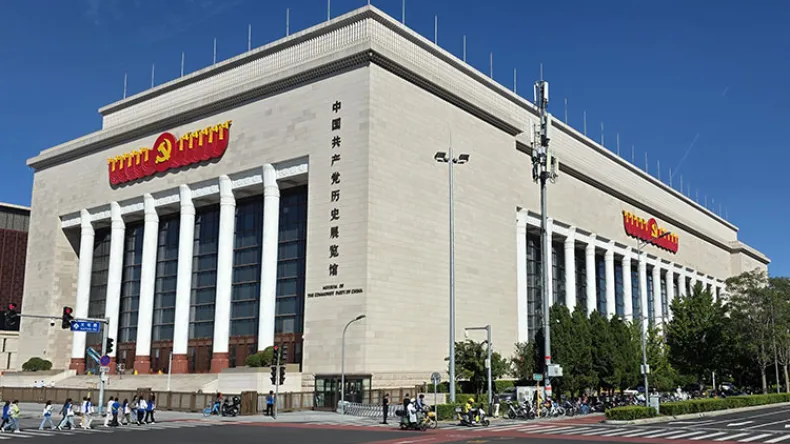
A recent visit to the Communist Party Museum in Beijing documented the history of the Chinese Communist Party from its founding in 1921 to modern China, offering profound insights into the nation's remarkable development trajectory. The museum, which officially opened its doors on June 18, 2021, a date strategically chosen to coincide with the 100th anniversary of the founding of the Chinese Communist Party, serves as a full chronicle of the country's evolution. Exhibits within the museum provided a detailed narrative of China's journey, showcasing key moments and significant achievements that have shaped its contemporary status. Among the notable displays was a "Hongqi, or 'Red Flag'," which the article described as "one of the most famous brands associated with the history of Chinese car manufacturing and official ceremonies in the country." This iconic vehicle symbolizes the early aspirations and subsequent successes of China's indigenous industrial capabilities. The museum also showcased other monumental achievements, such as the Chang'e-5 mission, with the article noting it "succeeded in returning samples from the lunar surface to Earth, an achievement that placed China among the few countries capable of carrying out such a mission." These exhibits collectively showed China's rapid ascent in both industrial prowess and scientific exploration. The article further noted China's current industrial standing, stating, "China today is the largest car production base in the world, with a growing presence of its brands in international markets, especially in the field of electric cars, with a very large presence of its vehicles of various types in the Algerian market." This global footprint in automotive manufacturing reflects a broader trend of Chinese economic influence and technological leadership.
Echoes of History and Ambition
The Communist Party Museum in Beijing officially opened on June 18, 2021, a date chosen to coincide with the 100th anniversary of the founding of the Chinese Communist Party, marking a significant milestone in the nation's historical commemoration. A recent visit to the institution spanned two and a half hours, offering an extensive and immersive overview of China's historical and industrial advancements. This dedicated exploration allowed visitors to delve deep into the narrative of the Chinese Communist Party from its inception in 1921 through to the complexities and achievements of modern China. Exhibitions within the museum detailed numerous milestones, including the foundational development of the Hongqi car. The first Hongqi car model was developed in 1958, marking a significant and ambitious step in China's nascent automotive industry. Its initial prototype was completed specifically on August 1, 1958, a date that represents the birth of a brand that would become synonymous with national prestige and official use. The museum's full documentation of such events paints a vivid picture of a nation committed to self-reliance and continuous progress, from early industrialization efforts to its current status as a global economic powerhouse. The careful presentation of these historical details provides context for understanding China's current ambitions and its strategic approach to development.
Technological and Industrial Prowess
China stands today as the largest car production base in the world, a testament to its formidable industrial capacity and strategic economic planning. Its automotive brands are not only dominating the domestic market but are also rapidly expanding their presence in international markets, particularly within the burgeoning electric car sector. This expansion includes a significant and noticeable presence of Chinese vehicles across various types and models in the Algerian market, according to the article, demonstrating the global reach and competitive edge of Chinese manufacturing. The nation's technological ambitions, however, extend far beyond terrestrial industries and automotive manufacturing. The Chang'e-5 mission successfully returned lunar samples to Earth in December 2020, an extraordinary feat of space exploration. This achievement positioned China among a select and elite group of countries capable of executing such a complex and challenging mission, showcasing its advanced capabilities in aerospace engineering and scientific research.
Looking ahead, China has articulated a clear and ambitious goal to achieve a per capita income level comparable to that of developed countries by 2035. This long-term aspiration underpins many of its current development strategies, driving innovation and economic reforms across various sectors. The country's immense industrial capacity, particularly evident in automotive manufacturing, reflects a broader and concerted push for technological self-reliance and deeper global market integration. The article details China's status as the world's leading car production base, noting the increasing international footprint of its brands, which are becoming increasingly recognized for their quality, innovation, and competitive pricing. This includes a substantial presence of various Chinese vehicle types in the Algerian market, showing the impressive reach and impact of its industrial output. The successful return of lunar samples by the Chang'e-5 mission in December 2020 further demonstrates China's advanced capabilities in high-tech engineering and space exploration, solidifying its position as a frontrunner in scientific and technological advancements. These achievements highlight a strategic vision that combines industrial growth with advanced research, aiming for full national development.
Lessons for Algeria's Future
The article draws compelling parallels between China's remarkable developmental trajectory and Algeria's potential aspirations, suggesting that China's journey offers invaluable insights and a potential model for the North African nation. China is currently the second largest economy in the world, a position achieved through decades of sustained growth, strategic planning, and significant investment in infrastructure and technology. The article notes how China's advancements, particularly in critical industrial sectors, could serve as an instructive model for Algeria's own development goals. For instance, the "Hongqi, or 'Red Flag'," is identified as "one of the most famous brands associated with the history of Chinese car manufacturing and official ceremonies in the country," showcasing not just a product, but a symbol of indigenous industrial growth and national pride. The museum's detailed account of the Hongqi's development, from its first prototype completed on August 1, 1958, illustrates the dedication and perseverance required to establish a strong domestic manufacturing base.
China's current industrial standing is further elaborated, with the article stating, "China today is the largest car production base in the world, with a growing presence of its brands in international markets, especially in the field of electric cars, with a very large presence of its vehicles of various types in the Algerian market." This demonstrates successful integration into global markets, a commitment to technological innovation, and an ability to scale production to meet international demand. The nation's scientific achievements are also presented as indicative of its capabilities and future potential, as "The Chang'e-5 mission, which in December 2020 succeeded in returning samples from the lunar surface to Earth, an achievement that placed China among the few countries capable of carrying out such a mission." These examples collectively show China's capacity for rapid economic and technological progress, driven by long-term vision and strategic implementation. The article implies that these successes could inform Algeria's own development strategies, particularly as Algeria seeks to diversify its economy and enhance its industrial capabilities. The museum visit, lasting two and a half hours, provided a full look at how China has leveraged its resources and political will to achieve its ambitious goal of reaching a per capita income close to that of developed countries by 2035. This holistic approach to development, encompassing industrialization, technological advancement, and strategic global engagement, presents a compelling case study for nations like Algeria charting their own paths to prosperity.