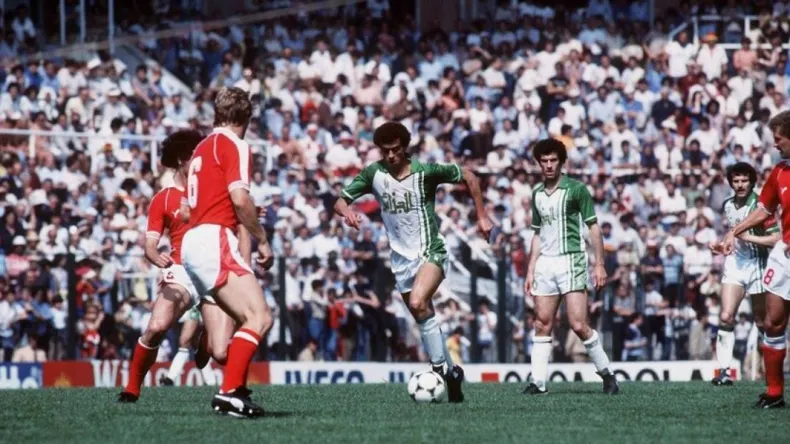
Algeria's national football team faced a key match against Austria in the 1982 World Cup, needing a victory to secure direct qualification for the second round. This key encounter followed Algeria's notable win over West Germany in the tournament, a triumph that offered a sense of relief amidst a tense international political climate. The year 1982 was marked by significant global unrest, including a particularly volatile situation in the Middle East. Israel's invasion of Lebanon during this period led to widespread destruction and massacres of Palestinian refugees, contributing to a deeply tense international atmosphere. Against this backdrop, Algeria's victory on the football pitch provided a moment of shared joy and pride. The Algerian team's journey in the World Cup had captured significant attention, noting the importance of the upcoming match against Austria for their progression in the competition. The stakes were high, with their performance against Austria determining their fate in the prestigious global event.
A Historic Upset's Echo
Algeria's victory over West Germany marked a significant moment, representing the first time an Arab or African nation had defeated a previous World Cup winner. This triumph occurred amidst a tense international situation in 1982, characterized by Israel's invasion of Lebanon, which led to massacres of Palestinian refugees and widespread destruction in Lebanon. The victory was widely celebrated, serving as a balm amidst the geopolitical turmoil. Following Algeria's win, celebrations erupted across Algeria and other Arab countries after Kuwait secured a draw against Czechoslovakia in another match, further amplifying the sense of collective achievement and hope.
In the same group, Austria had previously demonstrated their capabilities by defeating Chile 1-0, with Schachner scoring the decisive goal in the 21st minute. West Germany also faced Chile, defeating them comprehensively with a 4-1 scoreline; Rummenigge scored a hat-trick and Weinders added one goal in that encounter, showcasing the strength of the group's European contenders. These earlier results set the stage for the critical match between Algeria and Austria, emphasizing the competitive nature of Group 2. The article is dated June 3, 2026.
The Match in Oviedo
Algeria faced Austria in Oviedo on June 21st, 1982, in a match officiated by Australian referee Boskovič. A crowd of 22,000 spectators gathered for the key encounter, eager to witness the outcome that would shape the group's standings. The atmosphere was charged with anticipation as both teams vied for a spot in the next round. The match ultimately concluded with a final score of Austria 2 - Algeria 0.
Algeria's starting lineup for this key game featured a strong contingent of players: Mansouri, Guerioui, Ghandouz, Fergani, Madjer, Dahleb, Zidane, Belloumi, Assad, Serbah, and Merzgan. These players were tasked with securing the win needed for direct qualification. Austria, coached by the German Schmidt, presented a formidable team including goalkeeper Consilia, Kris, Obermair, Di Georgi, Pezzey, Hittenberger, Schachner, Prohaska, Krankl, Hintermaier, and Baumister. Their tactical discipline and individual skill would prove challenging for the Algerian side.
The first goal for Austria came against the run of play, scored by Schachner, shifting the momentum of the match. In the second half, Algeria made two substitutions in an attempt to change their fortunes and inject fresh energy into their attack. Ben Saoula replaced Belloumi in the 64th minute, and Jemal Tlemsani took the place of Mustapha Dahleb in the 76th minute. Despite these changes, Austria extended their lead when Krankl scored the second goal for his team in the 67th minute, solidifying their victory and effectively ending Algeria's hopes of progressing directly to the next round. The final score, Austria 2 - Algeria 0, meant Algeria's hopes for direct qualification to the next round were dashed, leaving them in a precarious position within the group.
Tactical Missteps and Criticism
The Algerian team's primary error against Austria was approaching the match with the conviction of being the superior side facing a weaker opponent. This mindset affected their strategy, particularly as coach Mahieddine Khalef attempted to dictate the game's pace. Algeria's tactical strength during that period typically lay in its counter-attacks, capitalizing when adversaries initiated play and leaving themselves open. However, in the encounter with Austria, the team deviated from this effective approach, with Khalef's decision to try and control the game proving to be a critical miscalculation. This departure from their established and successful counter-attacking style ultimately hindered their performance.
Following the match, both the Spanish and Algerian press voiced criticism directed at Algerian coach Mahieddine Khalef. The criticism gained traction partly because a draw would have been sufficient for Algeria to secure qualification for the next round, making the 2-0 defeat particularly disappointing. Khalef's tactical decisions came under intense scrutiny, especially the shift away from the team's established counter-attacking prowess that had served them so well in previous matches, including their historic win against West Germany. The outcome of the match, a 2-0 defeat, intensified the focus on these strategic choices and their significant impact on Algeria's World Cup progression, leaving fans and commentators to ponder what might have been if the team had stuck to its strengths.