Recent videos from influencers discussing dowry, marriage, and societal relationships have gained widespread attention in Algeria, sparking considerable public debate. These digital discussions highlight evolving perspectives on traditional customs and the financial aspects of marital unions within the country. The content often explores the societal pressures and expectations associated with dowry payments, prompting broader public dialogue about their implications for individuals and family structures. Influencers are using platforms to critically examine the role of dowry in contemporary Algerian society, questioning its impact on gender dynamics and the institution of marriage itself. This trend reflects a growing public engagement with culturally sensitive topics through new media channels, bringing once private discussions into the public sphere.
Regional Variations and Family Influence
The dowry system in Algeria exhibits significant regional variations, influenced by local customs and long-standing traditions across different areas of the country. This regional divergence means that the expected value or form of the dowry is not uniform nationwide, with expectations shifting considerably from one locale to another. In certain instances, the decision regarding the dowry amount or its components is primarily determined by the families involved in the marital arrangement, reflecting deeply ingrained cultural practices. This family influence often reflects a continuation of traditional practices where parents or elders play a central role in negotiating the terms of marriage, emphasizing communal and familial approval over individual preferences. The dowry, therefore, becomes a reflection of these diverse regional customs and the enduring authority of family units in marital negotiations.
Dowry as a Price Tag
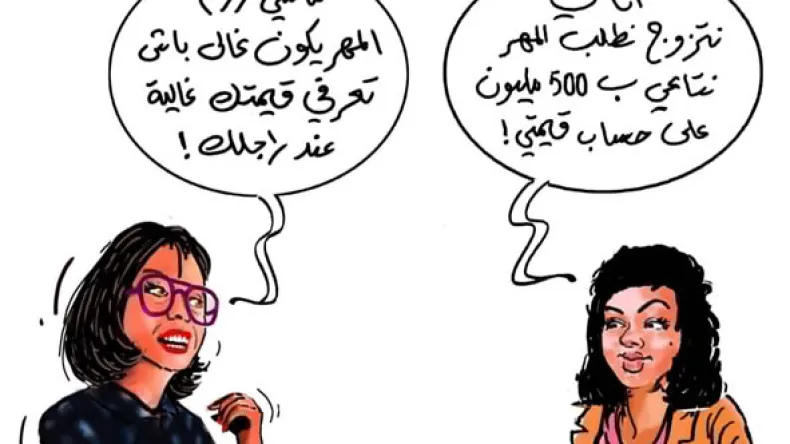
Many Algerian girls promote the idea that a woman possesses a price, with a specific dowry amount determined by her beauty, physical attributes, and academic achievements. This perspective transforms the dowry from a foundational pillar of marriage into the perceived price of a commodity to be exchanged, fundamentally altering its traditional significance. Some influencers on social media platforms have claimed their dowries reached substantial figures, with some stating sums exceeding "300 مليون" or "500 مليون." These influencers imply a direct correlation between a woman's perceived value and the financial compensation sought, reinforcing the notion that a woman can be quantified by a monetary sum. The practice reflects a growing trend where marital negotiations increasingly focus on financial valuations rather than traditional marital union principles, leading to concerns about the commodification of women. This shift challenges the spiritual and social foundations of marriage, reducing it to a transactional agreement.
Marriage Success vs. Dowry Amount
The article contends that a substantial dowry does not assure the longevity or success of a marriage. It posits that some unions initiated with high dowry payments have dissolved within a few months, demonstrating that financial outlay does not guarantee marital stability. Conversely, the analysis suggests that marriages founded on more modest dowry amounts have frequently led to the formation of cohesive and enduring families, noting the importance of factors beyond monetary value. This perspective challenges the notion that financial compensation directly correlates with marital stability or happiness in Algerian society. The argument notes a divergence between the perceived value of a high dowry and the practical outcomes of marital life, suggesting that true marital success is built on mutual understanding and commitment, not financial transactions.
True Value Beyond the Number
The article asserts that a woman's true worth transcends the dowry she receives. It suggests her value is found in her contributions to the marital relationship, her husband, her family, and the broader society, rather than in a monetary sum. This perspective emphasizes the intangible qualities and efforts that truly enrich a marriage and a community, advocating for a re-evaluation of what constitutes a woman's worth.