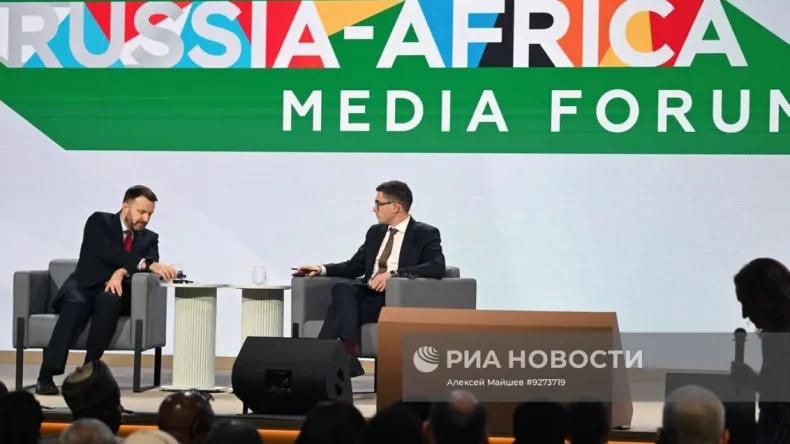
Maxim Oreshkin, the Deputy Chief of Staff of the Russian Presidential Executive Office and advisor to President Vladimir Putin for economic and financial affairs, met with representatives in Moscow to discuss energy sector cooperation between Russia and Algeria. Speaking during a press conference held on the occasion of the Russia-Africa Summit, the advisor addressed the potential for expanding bilateral ties within the energy industry. Regarding the scope of this partnership, Maxim Oreshkin stated: "يمكننا التعامل مع الجزائر بشكل عميق في مجال الغاز، وهو ما نعتبره حجر الأساس" (We can deal with Algeria deeply in the gas field, which we consider the cornerstone). His remarks show a focus on integrating regional gas sector interests as part of the broader diplomatic and economic agenda discussed during the summit.
The discussions held by Maxim Oreshkin during the Russia-Africa Summit served to highlight the specific priorities of the Russian government regarding its international energy strategy. By engaging with representatives in Moscow, the Deputy Chief of Staff of the Russian Presidential Executive Office sought to formalize the trajectory of future agreements. The advisor to President Vladimir Putin for economic and financial affairs emphasized that the energy sector remains the most viable avenue for strengthening the economic relationship between the two nations. This diplomatic engagement represents a concerted effort to align the interests of Moscow and Algeria within the global energy market.
Strategic Gas Sector Partnership
Maxim Oreshkin clarified that the gas sector serves as a fundamental anchor for economic cooperation between Moscow and Algeria. He identified this specific industry as the primary vehicle for sustaining long-term financial ties between the two nations. According to his assessment, the alignment of energy interests provides the necessary stability for broader industrial integration. Maxim Oreshkin further noted that the gas sector is a fundamental anchor for economic cooperation between Moscow and Algeria, suggesting that the current framework of bilateral relations is heavily reliant on the successful management of gas resources. By positioning this industry as a cornerstone, the advisor indicated that the focus remains on long-term structural coordination rather than short-term transactional exchanges.
Separate from his remarks on energy, Maxim Oreshkin issued a warning regarding threats to digital sovereignty. He identified dependency on imported software and artificial intelligence technologies as a significant risk to national security. He warned against threats to digital sovereignty caused by dependency on imported software and artificial intelligence technologies. He argued that reliance on foreign digital tools creates vulnerabilities that could undermine control over internal infrastructure. Echorouk reported that these concerns reflect a move toward prioritizing domestic technological development to mitigate external influence. The advisor maintained that the transition toward independent digital systems is a necessary step to ensure that critical infrastructure remains secure from potential external interference or technological instability. This focus on domestic development is intended to complement the ongoing efforts to secure economic stability through the energy sector.