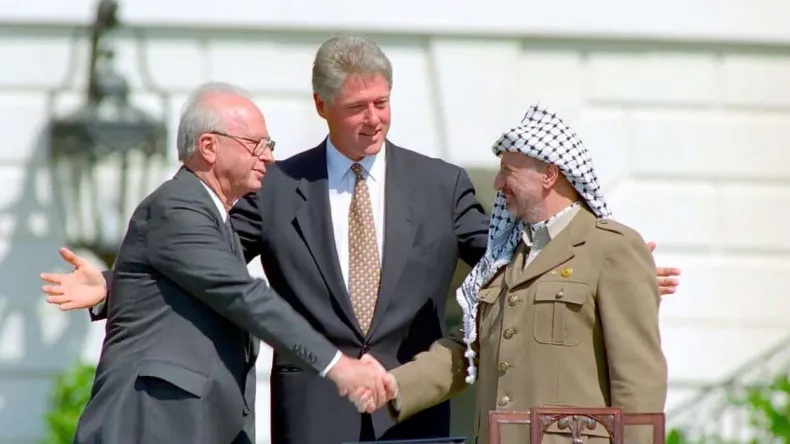
The Oslo Accords, signed on September 13, 1993, were intended to establish a permanent settlement within five years between Israelis and Palestinians. As the agreement marks its 33rd anniversary, the article questions its legacy, reflecting on the unfulfilled promises and the enduring challenges. The initial vision for the accords was to pave the way for a lasting peace, culminating in a definitive resolution of the Israeli-Palestinian conflict within a specific timeframe. However, three decades later, the intended permanent settlement remains elusive, and the interim arrangements have solidified into a protracted status quo.
The article critically asks, "What is the feasibility of an authority that bets on negotiating with the occupation while the occupying party continues to change facts on the ground and time does not always favor the weaker party?" This fundamental question shows the inherent power imbalance that has characterized the post-Oslo era. The article further states that the agreement transformed the core issue "from a cause of a people seeking freedom, return to their land and homes, and independent decision-making, into matters of authority, governance, administration, salaries, ministries, elections, and VIP cards for authority officials." This shift, it argues, has reoriented the Palestinian national struggle away from its foundational principles and towards the intricacies of day-to-day management under occupation, effectively diluting the broader aspirations for self-determination and liberation.
Dividing the Land and Entrenching Control
One of the most significant and lasting outcomes of the Oslo Accords was the establishment of a division of the West Bank into three distinct areas: A, B, and C. This tripartite division was initially conceived as a temporary measure to facilitate a phased transfer of authority. However, this arrangement has largely become permanent, shaping the geopolitical landscape of the West Bank.
Area C, which constitutes approximately 60% of the West Bank's territory, remains entirely under Israeli control. This extensive control includes security and administrative authority, significantly impacting Palestinian development and movement within these areas. The accords, despite their stated aim of moving towards a permanent settlement, did not prevent the continuation of settlement expansion in the region. In fact, the existence of Area C under Israeli control has often been cited as a facilitating factor for the growth of Israeli settlements, further fragmenting Palestinian territory and undermining the contiguity essential for a viable future state. The ongoing expansion of these settlements has consistently changed facts on the ground, making the prospect of a two-state solution increasingly difficult to achieve.
Authority Without Sovereignty
The Oslo Accords transformed the Palestinian Authority from a transitional mechanism into a permanent fixture, managing Palestinian affairs without full sovereignty. This evolution from a temporary body, intended to bridge the gap to statehood, into an enduring administrative entity has been a critical point of contention. The Palestinian Authority, while responsible for civil administration in Areas A and B, operates within significant constraints imposed by the ongoing Israeli occupation, lacking the full attributes of a sovereign state.
This shift also had profound implications for the broader Palestinian political landscape. The accords weakened the Palestine Liberation Organization (PLO) by refocusing efforts and resources onto the Authority's institutions. The PLO, historically recognized as the sole legitimate representative of the Palestinian people, saw its influence wane as the Palestinian Authority gained prominence in managing internal affairs and engaging with international donors. Concurrently, the Palestinian economy became heavily intertwined with the Israeli economy, leading to a significant dependency on foreign aid for its continued functioning. This economic reliance has created a fragile system, vulnerable to external pressures and hindering the development of an independent and self-sufficient Palestinian economy.
Deepened Divisions and Neglected Populations
The Oslo Accords primarily focused on Palestinians residing in the West Bank and Gaza Strip, a design that effectively overlooked millions of Palestinians living in refugee camps and abroad. This narrow scope meant that fundamental issues pertaining to the Palestinian diaspora, including the right of return for refugees, were largely deferred or sidelined, creating a profound sense of exclusion among a significant portion of the Palestinian people. This deliberate omission from the core negotiations has been a source of ongoing grievance and has contributed to the perception that the accords failed to address the entirety of the Palestinian national cause.
This narrow focus led to a deepening of internal Palestinian divisions. The agreements exacerbated the existing ideological rift within the Palestinian movement, polarizing factions between those advocating for continued negotiation with Israel and those committed to resistance as the primary means to achieve national rights. This internal fragmentation has had lasting consequences, contributing to political disunity and making it more challenging to present a united front in pursuit of Palestinian objectives. The accords, rather than fostering unity, inadvertently solidified existing schisms and created new ones, particularly regarding the strategic path forward for the Palestinian national movement.
A Failed Vision and Unresolved Issues
Ultimately, the Oslo Accords did not lead to the establishment of a Palestinian state, nor did they resolve the issue of Jerusalem, which remains a core point of contention. Settlements continued to expand unabated, further complicating any future territorial arrangements, and definitive borders for a Palestinian state were not drawn. The initial intention for a permanent settlement within five years was never realized, leaving the fundamental issues of the conflict unresolved.
The agreements ultimately failed to end the occupation, achieve Palestinian statehood, or offer a solution to the refugee problem. Thirty-three years after their signing, the occupation persists, the vision of an independent Palestinian state remains a distant aspiration, and the plight of Palestinian refugees continues without a just resolution. The legacy of Oslo, therefore, is viewed by many as one of crisis rather than peace, marked by unfulfilled promises and a perpetuation of the very conditions it aimed to resolve. The state of Palestine was not established, the issue of Jerusalem was not resolved, settlements did not stop, and borders were not drawn as a result of the Oslo Accords, leaving a bitter taste for those who had hoped for a different outcome.