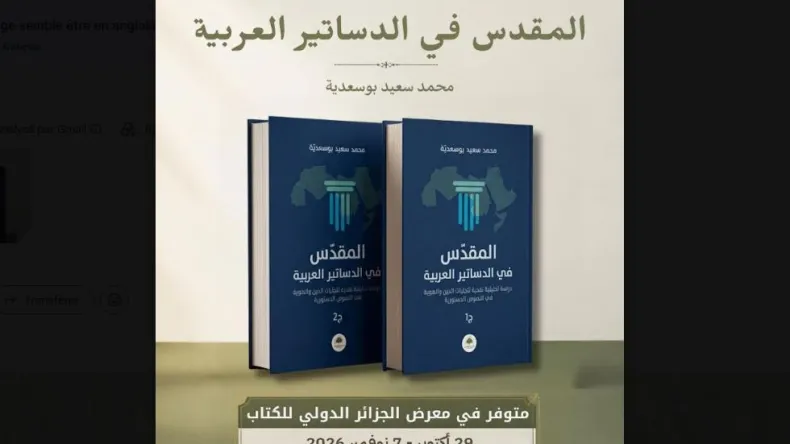
Algerian researcher Mohamed Said Bousaadia has released a study examining the role of religious references within legal frameworks across the Arab world. Titled "The Sacred in Arab Constitutions," the book provides an analysis of how religious doctrine is integrated into national governing documents. The Oxygen Foundation publishing house released the work, which explores the intersection of constitutional law and religious principles.
Scope of Constitutional Research
Mohamed Said Bousaadia includes all Arab countries in his analysis, spanning the entire Arab world. The research incorporates the Palestinian Authority and Western Sahara within its scope to provide a complete view of regional constitutional practices. By including these specific territories, the author seeks to ensure that the study encompasses the full breadth of legal systems currently operating within the Arab world.
Oxygen Foundation organized the content into 23 chapters to structure the analysis of these diverse legal frameworks. Each chapter focuses on a specific nation, with the book arranging these sections alphabetically by country name in English. This systematic approach allows readers to navigate the complex legal landscape of each country individually while maintaining a consistent comparative structure throughout the volume. By utilizing an alphabetical index, Mohamed Said Bousaadia provides a clear path for those researching the specific constitutional nuances of each sovereign state and territory included in the project.
The publication represents a significant effort to document how various Arab nations incorporate religious tenets into their foundational legal texts. The Oxygen Foundation publishing house has facilitated the distribution of this research, making it accessible to those interested in the relationship between state governance and religious doctrine. The book serves as a reference for understanding the evolution of these constitutional documents and the specific ways in which religious references are articulated in the legal codes of each nation.
Visitors can view the publication at the International Book Fair in Algiers. Organizers placed the book at the Palestine pavilion, located at booth C29. Attendees at the International Book Fair in Algiers have the opportunity to examine the text firsthand at the designated display area. The presence of the book at the Palestine pavilion notes the focus of the research on regional legal structures.
The work authored by Mohamed Said Bousaadia is currently available for public viewing during the event hours at the International Book Fair in Algiers. By placing the book at booth C29, the organizers aim to provide a centralized location for those seeking to learn more about the findings presented in "The Sacred in Arab Constitutions." The study remains a primary focus of the exhibition at this specific booth, allowing for direct engagement with the research findings documented by the author. The 23 chapters contained within the book offer a detailed breakdown of how each of the included Arab countries addresses the role of religious doctrine within its respective constitutional framework. This full collection of data serves as a resource for those examining the intersection of law and religion across the Arab world.