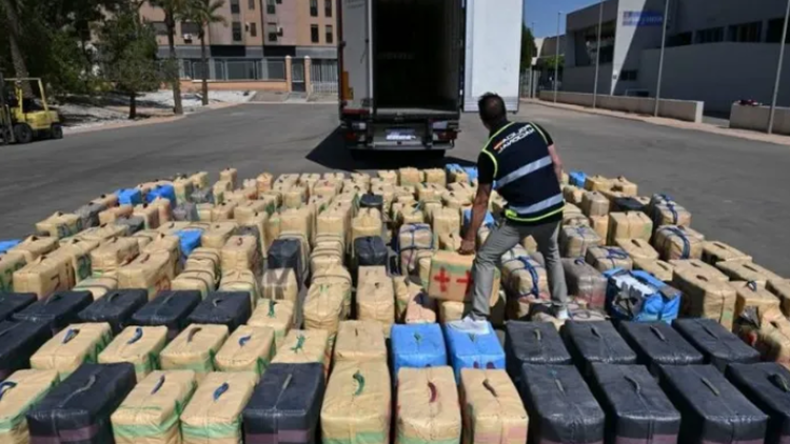
Spanish police recently announced the dismantling of a family network engaged in money laundering connected to hashish smuggling originating from Moroccan coasts into Spain. This significant operation targeted illicit financial flows generated by drug trafficking, which has become a persistent and growing concern for European law enforcement agencies. The network's activities showed the complex web of criminal enterprises that facilitate the movement of narcotics across international borders, posing a considerable challenge to regional security and financial integrity.
Investigations across Europe are broadening their scope to encompass sophisticated cross-border networks operating between Morocco, France, Spain, and Belgium. These concerted efforts aim to disrupt the complex logistical chains and financial mechanisms used by traffickers to move substantial quantities of narcotics, including both hashish and cocaine, into and across the continent. Such expanded investigations reflect a recognition of the interconnected nature of these criminal enterprises and the necessity of international cooperation to effectively combat them.
Hashish Smuggling Operations
The Spanish police operation, specifically named 'Samba', represented an extension of prior, extensive investigations conducted under the codenames 'Nightmare-Igrega'. These earlier inquiries laid the groundwork for the more recent actions, revealing the intricate structure and operational methods of the criminal organization. In 2024, law enforcement efforts, building on these investigations, resulted in the seizure of a significant 1.5 tons of hashish off the coast of Almería, Spain, noting the scale of maritime drug trafficking in the region. More than ten arrests were made during this particular operation, including individuals directly implicated in the money laundering activities that sustained the drug smuggling enterprise. These arrests were key in dismantling key components of the network, from its logistical operators to its financial facilitators.
Spanish police carried out four targeted searches in Melilla in late April as part of ongoing efforts to disrupt drug trafficking networks and their associated financial infrastructure. These careful investigations led to the precautionary seizure of five properties, collectively valued at approximately 960,000 euros. The seizure of these assets shows the financial impact of drug trafficking and the commitment of authorities to strip criminal organizations of their ill-gotten gains. Such measures are vital in weakening the economic backbone of these illicit operations and preventing further criminal activity.
Further interdictions occurred when Gibraltar authorities seized about 280 kilograms of hashish from a recreational boat. This vessel was reportedly traveling from Ceuta, a common transit point for illicit goods. In connection with the Gibraltar operation, two Moroccan individuals, both holding Spanish nationality, were arrested. Their arrests provided further insight into the transnational nature of these smuggling routes and the involvement of individuals with dual nationalities in facilitating cross-border drug movements. The continuous interdiction efforts by various European law enforcement agencies demonstrate a coordinated approach to combating the flow of hashish from Morocco into Europe.
Key Figures and Cocaine Trade
Issam Lahrech, widely known by his nickname 'La Blom' (The Feather), recently received a substantial 10-year prison sentence from the Criminal Court in Rennes, France. The court also levied a significant fine of 750,000 euros against him and mandated the forfeiture of Moroccan real estate assets valued at over one million euros. French media outlets have extensively reported on Lahrech, describing him as one of France's most prominent cocaine barons, noting his significant and influential role in the illicit drug trade that spans continents. His sentencing marks a notable success for European law enforcement in targeting high-profile figures within the drug trafficking hierarchy.
Law enforcement operations across Europe have consistently intercepted substantial cocaine shipments entering the continent, reflecting the persistent demand and the sophisticated supply chains. In 2022, authorities seized a shipment of over 360 kilograms of cocaine at the port of Montoir-de-Bretagne, a major entry point for maritime cargo. The following year, in September 2023, 23 kilograms of cocaine were confiscated at Orly Airport, indicating the use of air routes for smaller, high-value consignments. Additionally, another large shipment, estimated to be hundreds of kilograms, was seized during 2023, further showing the relentless scale of cocaine trafficking into the continent and the continuous efforts by authorities to interdict these illicit imports. These seizures collectively highlight the vast quantities of cocaine being moved into European markets and the dynamic nature of trafficking methods employed by criminal networks.
Moroccan Hub for Illicit Trade
Morocco has increasingly become a major hub for drug transit to Europe, facilitating the movement of both hashish and cocaine, according to various reports from law enforcement and intelligence agencies. This key role notes its strategic geographical position, acting as a critical nexus in the illicit trade routes connecting producer countries in South America and beyond with lucrative European markets. The country's extensive coastline and established smuggling networks make it a highly attractive point for traffickers seeking to move their illicit cargo into Europe.
Issam Lahrech, identified as one of France's most prominent cocaine barons, managed a significant part of his financial and commercial activities directly from Morocco for years. He conducted these sophisticated operations with a degree of impunity, often away from immediate judicial pursuits in Europe, indicating the country's utility as a base for illicit networks to operate with relative freedom. Lahrech's ability to orchestrate complex drug operations and manage his finances from Morocco shows the challenges faced by international law enforcement in dismantling these transnational criminal enterprises. His recent 10-year prison sentence from the Criminal Court in Rennes, France, alongside the substantial fine of 750,000 euros and the forfeiture of Moroccan real estate assets valued at over one million euros, serves as a stark reminder of the global reach of drug trafficking and the determination of authorities to pursue and prosecute those involved, regardless of their operational base.