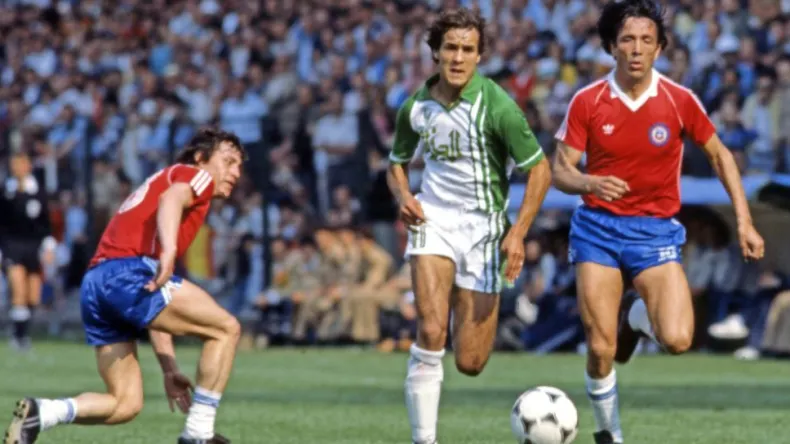
Algeria's national football team, affectionately known as 'El Khodor' (The Greens), experienced a dramatic and ultimately heartbreaking conclusion to their 1982 World Cup campaign. The team played its final group stage match against Chile, a key encounter that would determine their progression in the prestigious international tournament. The stakes were incredibly high for the Algerian squad, who had already made a significant impact in the competition.
First Half Dominance
The match between Algeria and Chile, held at Oviedo stadium, began with a display of overwhelming dominance from the Algerian side. From the opening whistle, 'El Khodor' asserted their control, exhibiting a fluid and aggressive offensive strategy that quickly yielded results. The team wasted no time in establishing a commanding lead, setting a furious pace that Chile struggled to match.
The first goal for Algeria came swiftly in the 7th minute, with Assaad finding the back of the net, igniting hopes for the North African nation. Assaad continued his impressive performance, scoring his second goal in the 31st minute, further extending Algeria's advantage and solidifying their control over the game. The relentless pressure from Algeria did not wane, and Ben Saoula added a third goal, unleashing a powerful shot from 20 meters out that found its mark. Throughout the first half, Algeria demonstrated significant offensive pressure, a testament to their attacking prowess, even hitting the woodwork three times, narrowly missing further opportunities to widen their lead. The match, a captivating spectacle for those in attendance, was officiated by Argentinian referee Maniz and drew a crowd of 16,000 enthusiastic spectators at Oviedo stadium, all witnessing a remarkable display of football from 'El Khodor'.
Second Half Collapse and Controversy
Despite their formidable first-half performance, the second half of the match saw a significant shift in momentum, leading to a partial collapse of Algeria's seemingly unassailable lead. Chile mounted a comeback, scoring two goals that dramatically reduced Algeria's advantage and introduced an element of tension into the game.
The defensive line of Algeria, which had held firm in the first half, began to show cracks. Serbah, the Algerian goalkeeper, conceded two goals. The first of these came from a penalty in the 59th minute, a key moment that allowed Chile to get on the scoreboard and build confidence. Later, Neira scored Chile's second goal in the 73rd minute, further narrowing the gap and putting pressure on the Algerian squad. In an effort to inject fresh energy and tactical adjustments, the Algerian coaching staff made substitutions during the second half. Algerian player Dhalab was brought in for Mansouri in the 73rd minute, aiming to reinforce the team's structure. Another significant change saw Yahya replace Bourbou. Yahya, who was 22 years old at the time, held the distinction of being the youngest player for 'El Khodor' in the tournament, representing the future hopes of Algerian football.
The Suspicious Austrian Match
While Algeria's match against Chile was unfolding, a concurrent and ultimately controversial game was being played in the same group, featuring Austria and West Germany. This parallel fixture would have profound implications for Algeria's fate in the tournament. The match concluded with a 1-0 victory for West Germany over Austria, a result that, under normal circumstances, would simply be noted. However, the nature of this outcome has been widely described as a "play" or "comedy," terms implying a pre-arranged agreement between the two teams to achieve a specific result that would benefit both, at the expense of Algeria.
The sole goal in this highly scrutinized match was scored by Robash for West Germany in the 10th minute of the game. After this early goal, the tempo of the match noticeably dropped, with both teams appearing to play out the remaining minutes with little urgency or intent to score further. This perceived lack of competitive drive fueled suspicions among observers and commentators. The match, attended by 41,000 spectators, saw West Germany secure the win, but the manner of their victory raised serious questions about fair play and sportsmanship. The referee for this suspicious encounter was Scottish official Bob Valentine, whose role involved overseeing a game that would later become a notorious example of alleged collusion in World Cup history.
Elimination and Legacy
Despite their impressive performance in the group stage, which included securing two victories, Algeria was ultimately eliminated from the 1982 World Cup. Their progression was tragically hindered by goal difference, a consequence directly linked to the controversial outcome of the Austria vs. West Germany match. The events of that tournament left a bitter taste for Algerian football fans and prompted significant changes in FIFA regulations. In response to the widespread belief that the Austria-West Germany game was fixed, FIFA subsequently amended its rules to ensure that the final group stage matches in all future World Cups would be played simultaneously. This change was specifically implemented to prevent any recurrence of such alleged collusion and to safeguard the integrity of the competition, ensuring that all teams have an equal and fair chance at advancement. The 1982 World Cup remains a poignant chapter in Algeria's football history, a tale of both sporting brilliance and profound injustice that continues to resonate decades later.