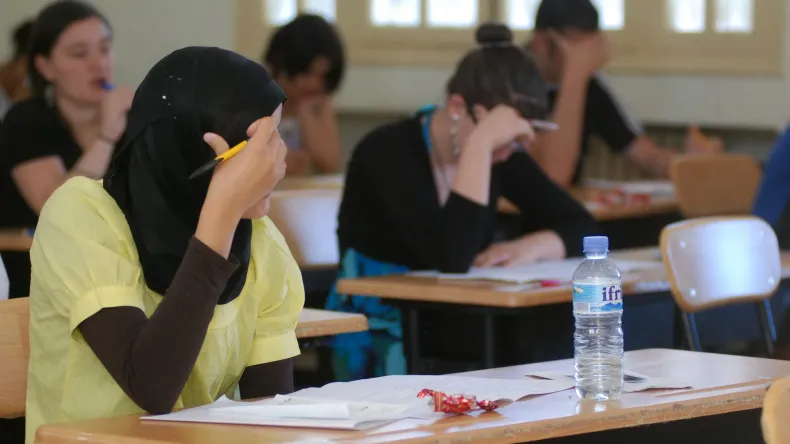
Algerian courts have recently imposed severe penalties on individuals involved in Baccalaureate exam leaks across several provinces, according to reports published on June 11, 2026. These stringent measures show the authorities' commitment to safeguarding the integrity of the national examination system. The Court of Chlef, for instance, sentenced defendants to five years of rigorous imprisonment and a significant fine of 50 million centimes for their roles in leaking French exam answers. This particular case noted sophisticated methods of illicit communication employed during the examination process. Meanwhile, the Court of Laghouat issued sentences ranging from four to five years of rigorous imprisonment, alongside substantial fines between 400,000 and 500,000 dinars, against five defendants found guilty of compromising exam integrity. In a separate case, the Court of Biskra ordered the detention of two defendants accused of leaking the Arabic language and literature exam subject, signalling a broad crackdown on such offences.
Details of Sentences and Cases
Further judicial actions demonstrate the widespread nature of these violations and the consistent response from the Algerian legal system. The Court of El Oued sentenced a defendant to three years of rigorous imprisonment and imposed a fine of 50 million centimes for publishing answers to the Arabic exam. This ruling reflects the serious view taken on the dissemination of examination content, regardless of the subject. In Tlemcen, two defendants received four-year rigorous imprisonment sentences after being found guilty of attempting to compromise the integrity of the Baccalaureate exams. Their conviction followed a thorough investigation into their coordinated efforts to illicitly obtain and distribute exam materials.
A separate incident in Cheraga involved a candidate who was caught photographing exam questions with his mobile phone. The candidate intended to send these images to his sister via the WhatsApp messaging application, illustrating a common digital method used for cheating. In the Laghouat case, which led to earlier reported convictions, the illicit activity involved the exchange of text messages containing answers for the Arabic exam. This method allowed for quick and discreet transmission of solutions, posing a significant challenge to exam invigilators. The various cases collectively paint a picture of diverse and evolving methods employed by individuals seeking an unfair advantage in the Baccalaureate examinations.
Technological Avenues for Cheating
The investigations have uncovered a range of advanced technological tools and communication methods used to facilitate cheating. In the Chlef case, the first defendant was discovered with a Bluetooth device attached to his chest and an earpiece while undertaking the French exam, allowing for covert reception of answers. The second defendant in that same case faced accusations of providing answers through remote communication methods, indicating a sophisticated network designed to bypass security measures. In Cheraga, the candidate's sister utilized the artificial intelligence application ChatGPT to formulate answers for the photographed exam questions, subsequently transmitting them back via WhatsApp. This incident marks a notable instance of AI technology being leveraged in exam fraud, presenting new challenges for examination bodies.
The Tlemcen investigation revealed a recorded phone conversation between the two defendants, detailing their attempt to leak exam answers, providing irrefutable evidence of their conspiracy. Separately, in Biskra, a student was found with a hidden Bluetooth earpiece during the examination and had contacted her sister by phone to obtain answers. This case, like others, shows the lengths to which some individuals go to circumvent the examination rules, often relying on external assistance facilitated by discreet communication devices. The recurring theme of concealed electronics and instant messaging applications notes the technological arms race between those attempting to cheat and the authorities striving to maintain examination integrity.
Judicial Response and Penalties
The Court of Cheraga, located in Algiers, issued decisive sentences against a free candidate and his sister for their involvement in leaking exam questions and answers. Both individuals received four years of rigorous imprisonment and were ordered to pay a fine of 200,000 dinars. This judicial action directly addresses their roles in compromising the integrity of the Baccalaureate examinations, serving as a clear deterrent to others. The court's decision reflects the ongoing efforts by Algerian authorities to counter exam fraud and uphold the fairness of the national assessment process. These recent rulings demonstrate a stringent approach to individuals attempting to disseminate or obtain exam content illicitly, reinforcing the severe consequences for such actions. The consistent application of harsh penalties across multiple provinces signals a unified national strategy to protect the credibility and value of the Baccalaureate diploma.