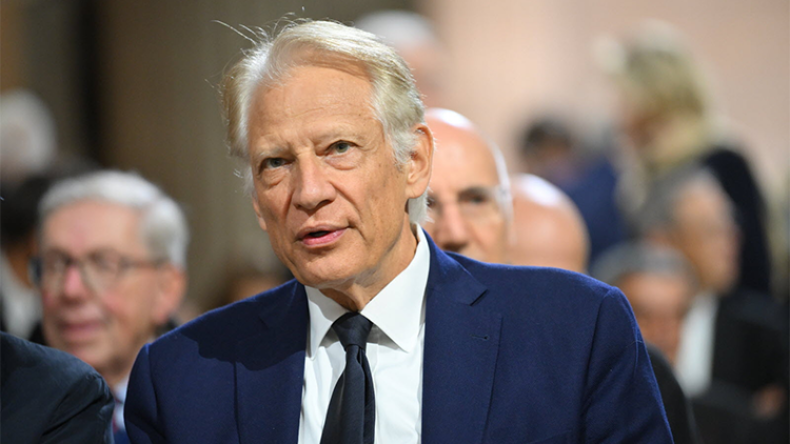
Former French Prime Minister Dominique de Villepin criticized Jordan Bardella, leader of the National Rally party, on Friday for what de Villepin described as discriminatory rhetoric targeting French citizens of non-French origins. De Villepin specifically mentioned Jordan Bardella, leader of the National Rally party, in his criticism, addressing him directly in a tweet on his X account. In this public statement, de Villepin condemned the alleged discrimination against Algerians and North Africans, calling out Bardella's implications. "When you attribute the violence that followed Paris Saint-Germain's victory to 'immigration,' who exactly do you mean?" de Villepin asked, challenging Bardella's premise. "Do you mean foreigners? Or those French people who were born here, grew up here, and were educated here, but whose names, neighborhoods, skin color, or presumed religion are enough, in your view, to make them suspect?"
De Villepin asserted that the Republic judges actions, not origins, and does not conflate criminals with an entire community. He stated, "You claim to restore order, but you sow doubt... This is not a republican logic. It is a logic inherited from the old legacy of the French far-right: one that sorts, classifies, and excludes." He emphasized that such an approach undermines the foundational principles of the French Republic.
Bardella's Accusations and Villepin's Rebuttal
Dominique de Villepin questioned Jordan Bardella's attribution of violence following Paris Saint-Germain's victory in the African Champions League to "immigration." De Villepin asked whether Bardella meant foreigners or French citizens born and raised in France whose names, neighborhoods, skin color, or presumed religion were enough to make them suspect. He further posed questions about when a person becomes fully French, asking if it occurred in the second, third, or fourth generation, and if individuals must meet a condition related to origin, appearance, or belief to be recognized as a legitimate child of the Republic. These questions noted de Villepin's concern about the criteria Bardella seemed to be applying to national identity.
Jordan Bardella, leader of the National Rally party, accused "youth of immigrant origins who do not miss an opportunity to express their rejection of institutions" and described them as "acting like predators." Bardella's rhetoric went further, as he incited French people of French origin against French people of immigrant origins, stating, "Wake up, because soon they will break down the doors of buildings and enter your apartments." Bardella also indicated that "this issue will be at the heart of the presidential elections," signaling his intention to make immigration a central theme of his political campaign.
De Villepin countered Bardella's assertions directly, stating that "the Republic prosecutes actions, not origins. It does not turn an individual mistake into a collective guilt. It does not confuse the criminal with an entire community, nor the French person with a foreigner, because their face, name, or family history does not please some people." This statement showed de Villepin's belief in individual accountability rather than collective blame based on background. He argued that Bardella's approach was fundamentally un-republican and divisive.
Divided Republic and Xenophobic Echoes
Dominique de Villepin described French society as divided into two warring factions, with one group considered French without question and another constantly required to prove its "Frenchness." He argued that this dynamic creates a profound rift within the nation, fostering an environment of suspicion and mistrust among citizens. This division, he contended, erodes national unity and the principle of equality among all citizens.
De Villepin warned that such a division is not a republican logic but one inherited from the old French far-right, which classifies, excludes, and has fueled xenophobia, racism, and anti-Semitism. He reiterated his stance that the Republic should judge actions rather than origins, and it should not equate individual wrongdoing with collective guilt. He emphasized that French citizens should not be treated as foreigners based on their appearance, name, or family history, as this undermines the very fabric of national identity. This historical context provided by de Villepin framed Bardella's comments within a long-standing, problematic tradition in French politics.
While condemning what he perceives as discriminatory rhetoric, de Villepin also explicitly denounced acts of violence and lawlessness. He stated that "whoever vandalizes must be punished. Whoever loots must be prosecuted. Whoever assaults must be condemned." This statement showed his position that maintaining order and prosecuting offenders is essential, but it should not be conflated with questioning the national identity of certain citizens. De Villepin's comments sought to draw a clear line between upholding the law and engaging in rhetoric that he views as discriminatory. He stressed that justice must be applied impartially, based on actions, not on a person's background or perceived origin.
Political Reactions and Electoral Stakes
French Minister of Justice Gérald Darmanin had previously characterized Jordan Bardella's statements as "inaccurate." Darmanin also urged the Member of the European Parliament, referring to Bardella, to allow the judicial system to operate "calmly" without political interference, implying that Bardella's comments were disrupting due process. Bardella's comments are widely interpreted as a formal declaration that his electoral platform for the upcoming presidential elections will center on attacking immigrants. The National Rally leader previously stated in Arabic, "استيقظوا، لأنهم بعد قليل سيقتحمون أبواب المباني ويدخلون شققكم" (Wake up, because soon they will break down the doors of buildings and enter your apartments), and showed the electoral significance of the issue. Bardella confirmed his stance by stating, "هذه القضية ستكون في صميم الانتخابات الرئاسية" (This issue will be at the heart of the presidential elections), reinforcing the view that immigration will be a cornerstone of his campaign strategy. This focus on immigration is seen as a deliberate move to mobilize his base and gain broader support in the upcoming elections.