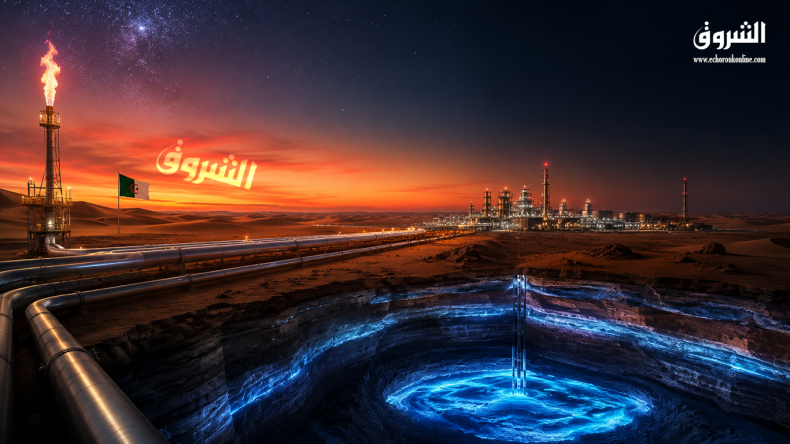
The U.S. Geological Survey (USGS) has released new estimates indicating substantial undiscovered gas resources in Algeria's Great Western Erg/Ahnet Basin region. This full assessment, which revealed estimates of undiscovered gas resources in the Great Western Erg/Ahnet Basin region of Algeria, marks a significant update to understanding the nation's energy potential. A scientific study published in April 2026 as Fact Sheet 2026-3005 reveals an estimated average of approximately 80.1 trillion cubic feet of technically recoverable gas. The assessment also projects an average of 275 million barrels of natural gas liquids within the same area. This full report outlines the potential for significant new energy supplies in the North African nation, reinforcing Algeria's role in the global energy landscape.
Resource Estimates Detailed
The U.S. Geological Survey (USGS) assessment indicates a broad range for these undiscovered resources, from a high confidence level (F95) estimate of 13.7 trillion cubic feet to a high statistical optimism level (F5) estimate of 191.2 trillion cubic feet. These figures represent the technically recoverable gas within the Great Western Erg/Ahnet Basin region. The study meticulously detailed the potential across various sub-basins and geological units.
The Timimoun Basin exhibits the largest potential within the studied area. Its Silurian gas unit holds the top ranking with an estimated average of 27.438 trillion cubic feet, making it the most significant individual accumulation identified. Following this, the Devonian gas unit in the Timimoun Basin is estimated to contain an average of 19.784 trillion cubic feet of gas, solidifying the basin's importance.
The Silurian gas unit within the Ahnet Basin is estimated at approximately 9.618 trillion cubic feet, contributing substantially to the overall regional potential. Another significant resource is the Silurian Wadi Mya unit, which holds an estimated 8.599 trillion cubic feet. The Devonian Ahnet unit contributes 5.391 trillion cubic feet to the overall estimate, further diversifying the resource base within the Ahnet region. Additionally, the Silurian Ben Ghedir-Melghir Depression has estimated resources of 5.123 trillion cubic feet, noting potential in other localized areas. The Sbaa Basin also contributes to the total, with its Silurian unit recording 2.220 trillion cubic feet and its Devonian unit holding 1.936 trillion cubic feet, collectively showing the widespread nature of these gas resources across the Great Western Erg/Ahnet Basin.
Geological Context Provided
The U.S. Geological Survey (USGS) study was prepared by an assessment team from the USGS's National and Global Petroleum Assessment Program, a specialized group focused on evaluating hydrocarbon resources worldwide. The assessment included two main petroleum systems: the Devonian system and the Silurian system, both of which are known for their hydrocarbon potential in various parts of the world. Detailed analysis of these systems revealed key geological characteristics indicative of significant gas generation and accumulation.
Specifically, Devonian shale rocks exhibit a high total organic carbon content, reaching up to 14%, which is a strong indicator of their capacity to generate hydrocarbons. These rocks also show a hydrogen index of approximately 580 mg hydrocarbons per gram of organic carbon, further confirming their richness in organic matter suitable for gas formation. These Devonian formations were found to have thicknesses up to 200 meters, providing ample volume for resource accumulation.
In comparison, Silurian rocks were found to have an organic carbon content of up to 10% and a hydrogen index of 380 mg/g, also representing favorable conditions for hydrocarbon generation, albeit slightly less than the Devonian shales in these specific metrics. The thicknesses of these Silurian rock formations are close to 100 meters, indicating substantial geological structures capable of holding significant gas reserves. The study additionally indicated the presence of overpressure phenomena in certain parts of the Ahnet Basin, a geological condition that can influence hydrocarbon migration and trapping mechanisms, often leading to more efficient resource preservation. These detailed geological insights are key for future exploration and development strategies in the region.
Algeria's Global Position
The U.S. Geological Survey (USGS) study findings elevate Algeria's standing as a globally promising region for unconventional gas resources. The significant estimates of undiscovered technically recoverable gas, ranging from 13.7 trillion cubic feet to 191.2 trillion cubic feet in the Great Western Erg/Ahnet Basin, position Algeria as a key area for future energy exploration. These results enhance Algeria's position as a promising region globally for unconventional gas, attracting attention from international energy stakeholders. The assessment notes specific basins such as Timimoun and Ahnet, and units like the Silurian and Devonian, as holding substantial potential for future development.
The identification of an estimated average of approximately 80.1 trillion cubic feet of technically recoverable gas, alongside 275 million barrels of natural gas liquids, contributes significantly to Algeria's profile as a country with considerable hydrocarbon wealth. This substantial resource base shows the nation's strategic importance in meeting future global energy demands. The detailed geological analysis, including high total organic carbon content and hydrogen index values in Devonian and Silurian rocks, further solidifies the scientific basis for these estimates and shows the favorable conditions for gas generation and accumulation within the assessed areas. The presence of overpressure phenomena in parts of the Ahnet Basin also indicates complex geological dynamics influencing resource accumulation, which are important considerations for extraction techniques. These full findings collectively reinforce Algeria's strategic importance in the global energy landscape, particularly concerning unconventional gas, and will likely spur further interest and investment in the region's energy sector.