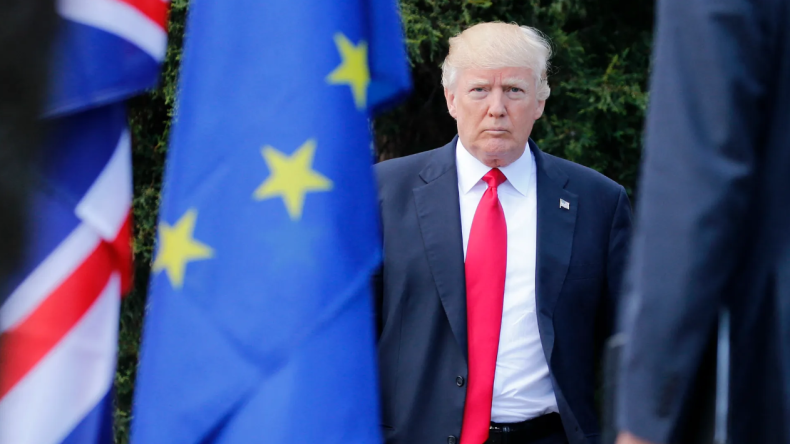
President Donald Trump has issued a July 4 deadline to European Union leaders for finalizing a trade agreement, threatening to impose significantly higher tariffs on European cars and trucks if a deal is not reached. During a phone call, President Trump conveyed this ultimatum to Ursula von der Leyen, stating, "I agreed to give her until our Country’s 250th Birthday or, unfortunately, their Tariffs would immediately jump to much higher levels." He warned that tariffs on European vehicles could rise to 25% from the current 15%. Trump claimed an agreement was initially reached in Turnberry, Scotland, which he referred to as an "اتفاق التجارة التاريخي" (historic trade agreement). Ursula von der Leyen affirmed, "We remain fully committed, on both sides, to [the trade deal’s] implementation. Good progress is being made towards tariff reduction by early July." Reports also indicated that good progress is being made towards tariff reduction by early July.
Trump's Trade Demands
On his platform Truth Social, Donald Trump claimed he had waited "بصبر" (patiently) for the EU to fulfill its obligations in what he termed an "اتفاق التجارة التاريخي" (historic trade agreement). Trump asserted that the European Union had promised to reduce its customs duties to zero. He set a two-month deadline for the EU to implement a trade deal with the U.S. Stating, "I agreed to give her until our Country’s 250th Birthday or, unfortunately, their Tariffs would immediately jump to much higher levels." This would see tariffs increase "فورا إلى مستويات أعلى بكثير". Jamieson Greer, who served as the U.S. Trade Representative's chief negotiator during the Trump administration, commented on the situation, saying, "We’re 95 percent compliant for nine months… and they’ve been 0 percent compliant during that time. What am I supposed to do?"
EU's Perspective and Progress
The trade agreement between the United States and the European Union has entered a sensitive phase, requiring further negotiation and approval from member states following its approval by the European Parliament in March. Ursula von der Leyen stated on social media that her recent call with Donald Trump primarily focused on the war in the Middle East, though trade discussions were also part of the conversation. The EU had reportedly agreed to remove tariffs on U.S. Industrial goods and commit billions of dollars to U.S. Energy and other industries in exchange for reduced tariffs on its own products. However, U.S. Trade Representative Jamieson Greer noted challenges, noting the EU has struggled to pass legislation lowering tariffs on U.S. Goods. He added that the EU has yet to begin addressing non-tariff barriers outlined in the original deal. Greer commented, "With the tariffs, they’ve at least started a process. They’re working it through. It’s a pain. I understand it’s slow. We’re not patient. But there are other things where they haven’t even started a process." He also asserted that the U.S. Has been "95 percent compliant for nine months… and they’ve been 0 percent compliant during that time."
Context and Underlying Tensions
Donald Trump reiterated his threat to impose higher tariffs on the European Union in a social media post on Thursday. The former president reportedly sought to penalize Berlin after Chancellor Friedrich Merz stated that the U.S. President had been "humiliated" during negotiations with Iran. This move also aimed to pressure the EU to expedite progress on the trade agreement. Ursula von der Leyen, President of the European Commission, emphasized, "we are united that Iran must never posses a nuclear weapon. Recent events have clearly shown that the risks to regional stability and global security are too great." She noted the shared concern regarding Iran's nuclear ambitions and regional stability.