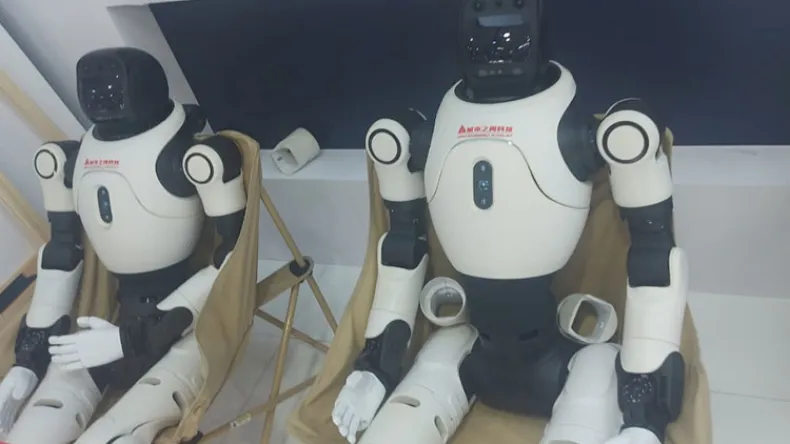
The 13th China International Fair for Trade in Services (CIFTIS) concluded recently in Beijing, showcasing a range of advanced robotic technologies. Held from September 9 to 13, the event provided a platform for companies to display innovations across various service sectors. The exhibition took place at the Shougang Industrial Park in Beijing, drawing attention to new developments in intelligent automation. This annual fair serves as a significant international platform for trade in services, attracting participants and visitors from around the globe eager to witness the forefront of technological innovation. The focus on robotics this year showed the rapid advancements in artificial intelligence and automation across various industries.
Diverse Robot Applications Demonstrated
Robots at the 13th China International Fair for Trade in Services (CIFTIS) demonstrated a range of applications, from entertainment to essential services. Attendees observed robots singing Chinese opera, engaging with the public, and facilitating product sales. These demonstrations offered a glimpse into the potential for robots to integrate into daily life and commercial activities, moving beyond purely industrial roles. The interactive nature of many exhibits allowed visitors to experience firsthand the capabilities of these advanced machines.
Beyond public interaction, the exhibition noted robots designed for practical industrial and commercial uses. Security patrols and logistics sorting were among the specialized functions showcased by the automated systems. These applications demonstrate the growing demand for robotic solutions in areas requiring precision, efficiency, and repetitive tasks. Such robots are designed to enhance operational safety and streamline complex processes in various sectors. Other robots offered direct services to visitors, including preparing coffee and drinks, providing translation assistance, and conducting health screenings. These service-oriented robots exemplify how automation can improve customer experience and provide support in public-facing roles. The versatility of these robotic platforms suggests a future where automated assistance is commonplace in many service industries.
City Link, a participant at the fair, presented a robot that performed Chinese opera and participated in live sales broadcasts. This particular demonstration drew significant attention, showcasing the blend of cultural performance with commercial utility. The company indicated that this particular robot was a key product for them in 2026, noting its strategic importance for future market penetration. The ability of the robot to engage in complex tasks like opera singing and dynamic sales pitches shows the sophistication of current robotic programming and design. Throughout the event, visitors were seen interacting with the displayed technology without hesitation, actively trying products and posing questions to representatives. This enthusiastic engagement from the public reflects a growing acceptance and curiosity towards advanced robotic solutions. The smooth interaction between humans and robots at the fair pointed towards a future where such technologies are integrated into everyday commercial and social environments.
Industry Leaders and Emerging Technologies
Several prominent companies showcased their latest advancements, demonstrating the breadth of innovation in robotics. Shadow AI (Yinxing Jinong) presented robotic solutions specifically designed for the shoe manufacturing industry. This technology is capable of replacing human workers in two distinct steps of shoe production, including the precise application of glue and the attachment of various shoe parts. The introduction of such specialized robots aims to enhance efficiency and consistency in manufacturing processes. The shoe manufacturing industry, known for its intricate and labor-intensive steps, stands to benefit significantly from such targeted automation. Shadow AI's focus on these specific, critical stages shows a strategic approach to robotic integration in industrial settings.
Another participant, LingSheng Technology, noted its focus on 'embodied intelligence'. This approach aims to connect advanced AI models directly to robots, enabling more sophisticated real-world interaction and functionality. Embodied intelligence represents a frontier in AI development, seeking to bridge the gap between abstract AI processing and physical interaction with the environment. LingSheng Technology is actively developing a system named 'Roda', which serves as a key link between robot hardware and large AI models, integrating intelligent agent capabilities. This system is designed to allow robots to process information, learn from their surroundings, and execute complex tasks with greater autonomy and adaptability. The development of 'Roda' signifies a push towards creating robots that are not just programmable machines but intelligent entities capable of nuanced decision-making and interaction.
City Link Technology, a company also present at the fair, demonstrated its progress in integrating diverse robotic systems. The company successfully integrated over 30 robots from different brands and types, showcasing collective control capabilities. This achievement is particularly significant as it addresses the challenge of interoperability among various robotic platforms. City Link Technology achieved significant progress in 2026 in the collective control of robots, allowing for the synchronization of more than 30 distinct robot models to work in concert. This collective control technology enables a coordinated effort among robots, opening up possibilities for complex automated tasks that require multiple machines to operate harmoniously. The ability to manage and synchronize such a large and diverse fleet of robots represents a major leap forward in robotic systems engineering.
The exhibition drew participation from major industry players, showing the event's significance. Companies such as Alibaba, Tencent, JD.com, Huawei, Xiaomi, and Lenovo were among the key exhibitors. Their presence notes the strategic importance these technology giants place on robotics and artificial intelligence. These companies are not only consumers of robotic technology but also significant developers and investors in the field. JD.com utilized the platform to showcase its extensive operations, which span various sectors including trade, technology, logistics, and health services. This broad display by JD.com illustrated how robotics and automation are integral to its diverse business ecosystem, from warehouse management to last-mile delivery and even healthcare solutions. The participation of these industry leaders reinforces Beijing's role as a hub for technological innovation and trade in services.
Market Landscape and Future Outlook
Robots from City Link Technology are available within a price range of 200,000 to 600,000 Chinese Yuan per unit. This pricing translates to approximately $30,000 to $90,000 USD. The most affordable humanoid robot offered by City Link Technology begins at 200,000 Yuan, which is roughly $30,000 USD. These price points indicate that while advanced humanoid robots are still a significant investment, they are becoming more accessible for commercial and industrial applications. The cost-effectiveness of these robots, when considering long-term operational benefits and increased efficiency, is a key factor driving their adoption.
While Chinese households have adopted simpler robotic devices, such as robotic vacuum cleaners, the widespread commercial use of full-sized humanoid robots remains in its early stages. The market for consumer robots has seen significant growth, with robotic vacuum cleaners becoming a common household appliance due to their affordability and practical utility. However, the transition to more complex, multi-functional humanoid robots for commercial or personal assistance is still nascent. This distinction notes the different stages of market maturity for various types of robotic technology. The current focus is on demonstrating their capabilities and proving their value proposition in specific industrial and service sectors before broader consumer adoption.
In the manufacturing sector, a single shoe's production process can involve up to 200 distinct steps. This complexity notes areas where robotic automation could be further integrated, offering solutions for precision, speed, and consistency. The intricate nature of such manufacturing processes makes them ideal candidates for robotic intervention, as robots can perform repetitive tasks with unwavering accuracy. Shadow AI's targeted solutions for shoe manufacturing exemplify this approach, addressing specific, labor-intensive steps within a complex production chain. Data essential for training advanced robots can be acquired through the observation and recording of human movement, providing a foundation for more sophisticated automated tasks. This method of learning by demonstration allows robots to mimic human actions, enabling them to perform tasks that traditionally require human dexterity and judgment. The collection and analysis of human movement data are key for developing robots that can operate effectively in dynamic and unstructured environments, paving the way for more intelligent and adaptable automated systems across various industries.