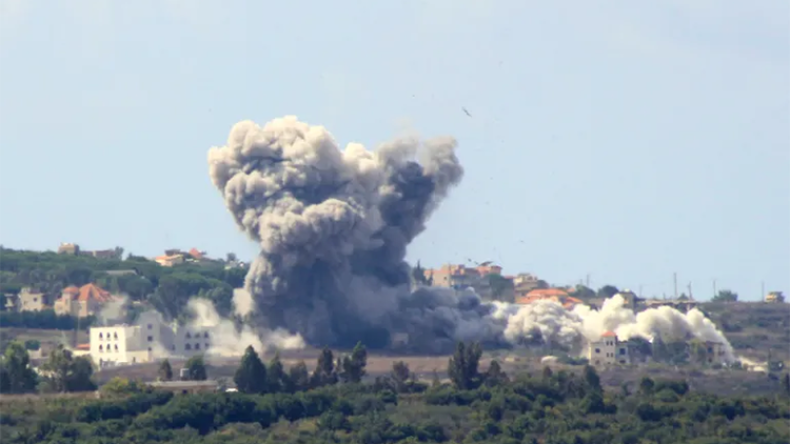
Lebanon's Prime Minister Nawaf Salam on Tuesday condemned Israeli strikes in Majdal Zoun that killed five people, including three rescue workers, and wounded two Lebanese army troops. Two successive Israeli attacks targeted a building, forces, rescue workers, and two civilian bulldozers in the southern Lebanese village. Prime Minister Salam accused Israel of perpetrating a "heinous crime" and a "war crime" by targeting civil defense emergency workers. He stated, "Targeting elements of the Civil Defence in Majdal Zoun, and their killing while carrying out their humanitarian duty, constitutes a new and described war crime perpetrated by Israel." Salam added that the incident "represents a flagrant violation of the principles and rules of international humanitarian law," and pledged, "The government will spare no effort to condemn this heinous crime in international forums and to mobilise all efforts to compel Israel to cease its ongoing violations of the ceasefire agreement."
Escalating Attacks and Casualties
At least eight people were killed in attacks across Lebanon on Tuesday. Lebanese President Joseph Aoun stated that these killings indicate Israel continues to violate international laws protecting civilians and humanitarian workers, particularly those safeguarding civilians and humanitarian personnel. Israeli forces reportedly attacked a Lebanese military patrol that was escorting civil defense workers. The death toll from Israeli attacks on Lebanon since March 2 has now risen to 2,534, with 7,863 people wounded. Within Lebanon, there is a continuous rise in support for the army's role in disarming Hezbollah through non-confrontational means, reflecting a desire for stability without further conflict.
Lebanese Rejection of Normalization
The aggression against Lebanon is attributed to the country's firm stance on the Palestinian cause, despite the numerous attacks endured and the high price paid. This steadfast position is seen as a primary driver for the ongoing targeting of the nation. Research from institutions including Israel's Institute for National Security Studies and the Begin-Sadat Center, alongside American research from the Carnegie Endowment, indicates that most Lebanese do not align with Israeli policies or support normalization. These findings highlight a deep-seated resistance to any rapprochement with the Zionist entity. A survey conducted by the Arab Index in its third cycle in February 2025 revealed that 89% of Lebanese reject recognizing or normalizing relations with 'Israel'. Additionally, 97% of Lebanese view 'Israel's' policy as a threat to regional security, considering it a colonial and racist state. While a minority viewpoint supporting full normalization with the Zionist entity is observed to be growing, it remains weak compared to the majority, estimated at around 9% by the Arab Index. Hezbollah has stated its acceptance of disarmament, contingent upon the prior liberation of land.
Alleged Israeli Expansionist Aims
The article asserts that fighting Hezbollah serves as merely a pretext for the Zionist entity to subdue Lebanese political will and push for normalization. This perspective suggests that the Zionist entity's doctrine relies on continuous expansion and an inherent distrust of any adjacent front, viewing its neighbors as perpetual threats to its existence and ambitions. The Israeli narrative, which claims to target Hezbollah without targeting Lebanon, is described as false, aiming to conceal a true objective of overthrowing or forcibly subjugating the Lebanese state to achieve complete normalization. This, the article argues, would pave the way for the extremist Israeli right's vision of 'Greater Israel' stretching from the Euphrates to the Nile, a territorial expansionist dream.
Lebanon is presented as paying a significant price for its unity as a people and a state, and for the integrity of its land, in an effort to prevent occupation and resist what is termed the Zionist logic of normalization or annihilation. The country's pluralistic nature and constitutionally guaranteed freedom of expression allow all parties to voice their opinions freely in the media, a contrast noted with the pro-Israeli media of the Zionist entity, which often presents a monolithic narrative. Ramzi Kaiss, a Lebanon researcher at Human Rights Watch (HRW), stated that the international community's silence has emboldened Israeli military actions, asserting, "Civilians are paying the price of the international community’s silence and unwillingness to hold Israeli officials to account." This silence, the article implies, allows for the continuation of actions that violate international humanitarian law and undermine regional stability.