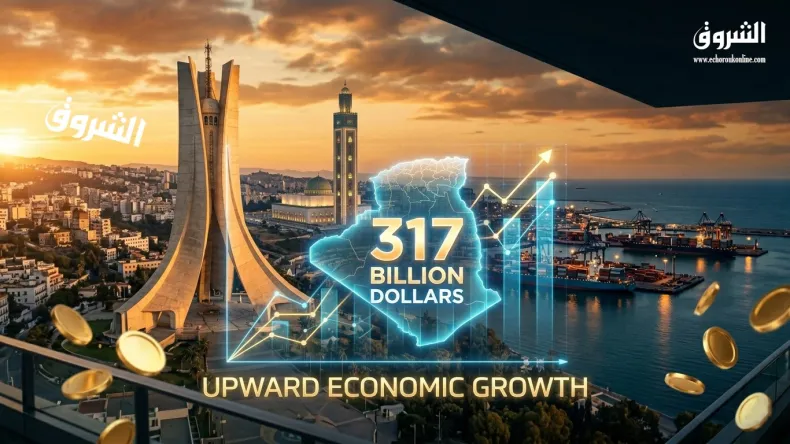
The International Monetary Fund (IMF) projects Algeria's economy to reach over 317 billion dollars by 2026, positioning it to become the fourth largest economy in Africa. This significant economic expansion is anticipated to redefine the nation's standing on the continent. According to the same data, Algeria's Gross Domestic Product (GDP) is specifically forecast to reach $317.17 billion in 2026. This growth would also establish Algeria as the leading economy within the Maghreb region, marking a key shift in the regional economic landscape. The IMF's assessment notes the strong trajectory of Algeria's economic development, showing its growing influence both regionally and continentally.
Economic Growth Forecast
Algeria's Gross Domestic Product (GDP) is projected to reach $285.72 billion in 2025, laying a strong foundation for future expansion. The International Monetary Fund (IMF) estimates the country's economic growth at 3.8 percent for the same period, signaling a healthy and sustained upward trend. This growth trajectory underpins forecasts for Algeria to become a leading economy in the region, reflecting consistent performance and strategic economic planning. The anticipated growth rate is a key indicator of the nation's economic vitality and its capacity to achieve ambitious development goals. Such sustained growth is key for consolidating its position as a major economic player in North Africa.
Understanding GDP Metrics
Estimates indicate Algeria's Gross Domestic Product (GDP) will reach $941.54 billion in 2026, when measured by Purchasing Power Parity (PPP). The Purchasing Power Parity standard is an analytical tool employed to compare price levels across different countries. This method considers differences in the cost of living and the prices of various goods and services within those economies, providing a more accurate representation of economic size and living standards. The GDP according to the PPP standard offers a distinct measure compared to nominal GDP, which is calculated based on official exchange rates. This distinction is key for understanding the real economic output and purchasing power within a country, providing a more full view of economic size when comparing nations with varying price structures. The PPP metric, by adjusting for these price differentials, gives a truer sense of what a country's currency can actually buy domestically, offering valuable insights beyond mere exchange rate conversions.
Regional Economic Standing
The International Monetary Fund's projections indicate that Algeria is poised to become the largest economy in the Maghreb region by 2026. This forecast places Algeria ahead of its North African neighbors in terms of economic output, signaling a significant shift in the balance of economic power. The Maghreb region, which includes countries like Morocco and Tunisia, has historically seen varying economic performances, making Algeria's projected ascent particularly noteworthy. Algeria's anticipated growth reflects internal economic policies and global market conditions that are converging to elevate its regional standing. This would mark a significant shift in the economic hierarchy of Northwest Africa, showing Algeria's growing influence and strategic importance. The IMF's assessment provides a benchmark for observing future economic developments within the region, as Algeria continues to implement strategies aimed at fostering sustainable growth and diversifying its economy. The country's economic policies are clearly yielding results, positioning it for continued leadership.