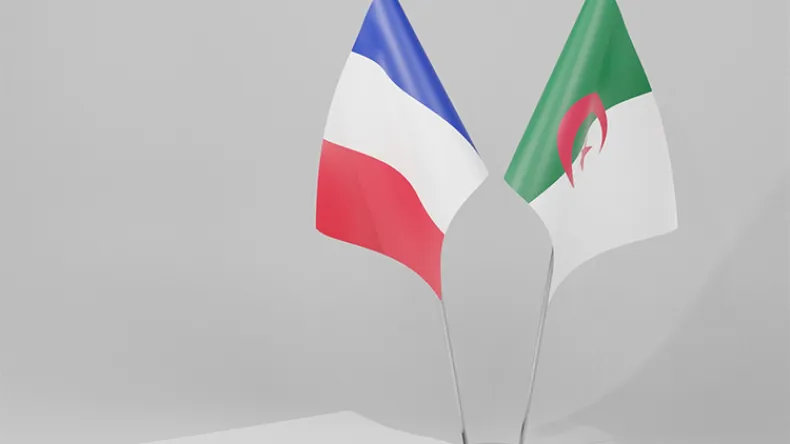
Recent statements from French officials indicate a clear duality in France's approach to Algeria, amidst a full and worsening crisis between the two countries that has spanned nearly two years. This duality in the French authorities' approach to Algeria has become increasingly apparent as the full crisis deepens. The crisis intensified following French President Emmanuel Macron's decision to align his country's stance on the Western Sahara issue, a move that significantly impacted Franco-Algerian relations. Within two days, three contradictory statements emerged from French authorities concerning relations with Algeria, according to reporting by Echorouk Online, noting the internal divisions within the French government. President Macron criticized political circles advocating for a break with Algeria on April 27, followed by contradictory statements from Interior Minister Laurent Nuñez and government spokesperson Maud Bregeon on the same day.
Maud Bregeon stated that "What the President of the Republic says is that the policy of non-communication has not borne fruit in a number of issues affecting Franco-Algerian relations." Bregeon added, "This is the practical approach followed by the President of the French Republic in dealing with the Algerian state." She further explained, "The policy of non-communication that has been tried, so to speak, has not led to an increase in the number of consular permits issued by Algeria." Instead, Bregeon noted, "On the contrary, the issuance of consular permits stopped for several months." This cessation of consular permits created significant challenges for France, particularly regarding the deportation of illegal residents.
Internal Divisions Emerge
The government of Sébastien Lecornu is reportedly divided into two factions regarding its approach to Algeria. One faction, advocating for de-escalation with Algeria, is represented by Interior Minister Laurent Nuñez, while another pushes for escalation, voiced by government spokesperson Maud Bregeon. This internal divergence within the government shows the complexity of managing relations with Algeria. Bregeon stated that President Emmanuel Macron believes "the policy of non-communication has not yielded results in several issues affecting Franco-Algerian relations." She added, "This is the practical approach followed by the President of the French Republic in dealing with the Algerian state."
Bregeon further elaborated that "the policy of non-communication that has been tried, so to speak, has not led to an increase in the number of consular permits issued by Algeria." She specifically noted that this approach had not proven effective in addressing various issues impacting Franco-Algerian relations. Instead, she noted, "On the contrary, the issuance of consular permits stopped for several months." This cessation of permits directly impacted France's ability to manage immigration issues. Earlier, former French Interior Minister Bruno Retailleau attempted to impose a hardline policy with Algerian authorities, which reportedly exacerbated the crisis. Retailleau's approach was seen by some as counterproductive, further straining the already tense diplomatic ties. French authorities have not used the phrase 'policy of firmness' in dealing with Algeria since August 2025, signaling a potential shift in official rhetoric.
Policy Shifts and Outcomes
The previous policy of non-communication between France and Algeria did not result in an increase in consular permits issued by Algeria, according to government spokesperson Maud Bregeon. Bregeon noted that this approach had not proven effective in addressing various issues impacting Franco-Algerian relations, particularly concerning consular matters. Instead, the issuance of consular permits, which are necessary for the deportation of illegal residents in France, ceased for several months under the previous policy, creating a significant backlog and operational challenges for French authorities.
The current French government, which succeeded a less moderate administration, has adopted a calmer diplomatic stance. This shift has reportedly contributed to the resumption of communication between France and Algeria, indicating a more pragmatic approach to resolving bilateral issues. As part of this renewed engagement, the new Interior Minister, Laurent Nuñez, undertook a visit to Algeria, a key step in re-establishing dialogue and cooperation. This visit was seen as a positive sign, aiming to mend the strained relationship and find common ground on critical issues.
Official Statements and Stance
French government spokesperson Maud Bregeon stated that France could earn Algeria's respect through a firm approach without severing diplomatic ties. This statement notes a nuanced strategy, seeking to project strength while maintaining open channels of communication. Bregeon affirmed that President Emmanuel Macron's view is that "the policy of non-communication has not yielded results in several issues affecting Franco-Algerian relations." She added, "This is the practical approach followed by the President of the Republic (of France) in dealing with the Algerian state." Bregeon noted that "the policy of non-communication that has been tried, so to speak, has not led to an increase in the number of consular permits issued by Algeria." She further explained, "On the contrary, the issuance of consular permits stopped for several months," showing the ineffectiveness of the previous strategy. The current approach, led by Interior Minister Laurent Nuñez, has reportedly been effective, resulting in Algeria issuing consular permits necessary for the deportation of illegal residents in France, a tangible outcome of the shift in diplomatic strategy. This success suggests that a more engaged and less confrontational approach may be yielding better results for both nations.