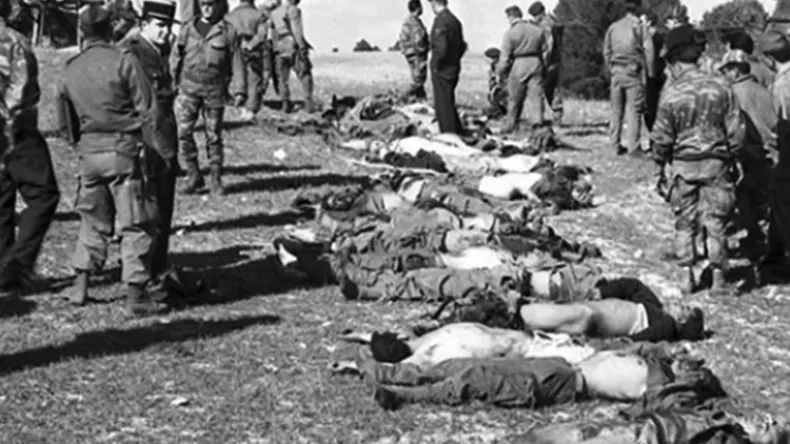
A narrative suggesting a "positive role of colonialism" by citing infrastructure projects built in Algeria between 1830 and 1962 as "gifts" or "huge investments" from French taxpayers is being challenged by scientific and historical analysis. This French colonial narrative, still echoed in some political and historical circles today, often points to the construction of vital infrastructure like railways, ports, and roads as evidence of a "positive role of colonialism." However, scientific and historical dismantling of colonial budgets and financial archives proves the opposite of this colonial narrative, indicating that French colonialism in Algeria was not an investment project funded by the metropole. Instead, it operated on a strict principle of "self-financing of colonialism." Funds for colonial projects were forcefully extracted from Algerian land, labor, and resources, primarily serving the settler minority and the imperial army. The money used for colonial projects was extracted forcefully from the wealth of the land, the labor, and the blood of Algerians. French governments ensured the colony did not constitute a financial burden on French citizens, effectively making Algeria pay for its own subjugation and exploitation.
Financing Colonial Ambitions
The Law of December 19, 1900, formally separated the French state budget from Algeria's colonial budget, legally mandating that Algeria finance all its administrative, educational, health, and infrastructure projects from its "own local revenues." This key legislation established a complete separation between the French state budget and the colony's budget in Algeria, legally obligating Algeria to finance all its administrative, educational, health, and infrastructure projects from its "own local revenues." This financial autonomy was overseen by the "Financial Delegations" (Les Délégations Financières) council, established in 1898. This council functioned as a mini financial parliament largely controlled by European settlers, enabling them to direct tax policy and public spending to benefit their interests, while simultaneously imposing the heaviest tax burden on the Algerian population.
Algerians faced a dual and inequitable tax system, which included "Arab taxes" (Impôts arabes) such as 'Oushour' on crops and 'Lazâm' on livestock, levied until World War I. These "Arab taxes" specifically targeted the indigenous Algerian population, differentiating them from taxes imposed on European settlers. 'Oushour' was a tax on agricultural produce, directly impacting Algerian farmers, while 'Lazâm' was levied on livestock, affecting nomadic and pastoral communities. Despite widespread poverty, Algerians contributed the largest portion of the colony's tax revenues. These funds were then allocated to infrastructure projects, including roads and ports, primarily to connect settler farms to export facilities, while Algerian villages often remained isolated, lacking schools or hospitals. Algerians, despite living in extreme poverty, paid the largest share of the colony's tax revenues, which were used to build roads and ports connecting settler farms to ports for exporting wealth, rather than developing the regions inhabited by the indigenous population.
The colonial administration systematically confiscated millions of hectares of fertile land and Islamic Waqf properties. This process was facilitated by laws such as the Warnier Law of 1873 and subsequent legislation that confiscated tribal lands following popular resistance movements, including those led by Mokrani and Sheikh Haddad in 1871. The Warnier Law of 1873, in particular, aimed to dismantle communal land ownership and facilitate the transfer of land to European settlers. The colonial administration confiscated millions of hectares of fertile land and Islamic Waqf properties, which were traditional endowments for religious and charitable purposes, through these legislative acts. The proceeds generated from the sale and concessions of these confiscated lands were subsequently utilized to finance infrastructure development and cover French administrative expenses within the colony, further illustrating the self-financing nature of the colonial enterprise.
Labor and Debt
When large infrastructure projects, such as extensive railway lines, were required, the colonial administration typically financed them by issuing loans and bonds in Paris. This meant that when large projects like long railway lines were needed, the colonial administration issued loans and bonds in Paris, with Algeria's budget (i.e. Algerian taxes and wealth) obligated to repay these debts with interest over decades. Algeria's budget, which comprised Algerian taxes and wealth, was obligated to repay these debts with interest over decades. The French central treasury in Paris only intervened with direct funds for military and security spending, not for development projects within the colony. The French central treasury only intervened with direct funds from Paris for military and security spending, showing that development costs were always borne by the colony itself.
The Indigénat law provided the colonial administration with the authority to impose forced labor, known as corvée, on Algerians for infrastructure projects. This labor was often performed without pay or with only symbolic wages. The Indigénat law allowed the colonial administration to impose forced labor (corvée) on Algerians for infrastructure projects without pay or with symbolic wages, a practice that was widespread and highly exploitative. Algerians constituted a vulnerable labor force, largely deprived of union rights, which significantly lowered the production costs for these projects. This systematic exploitation of labor further reduced the financial burden on the colonial administration and, by extension, on French taxpayers, ensuring that the infrastructure was built at minimal cost to the metropole.
A Failed Political Gambit
The only instance where direct French funds were channeled into Algeria occurred with the "Plan de Constantine," announced by General Charles de Gaulle in October 1958. This initiative was introduced during the height of the National Liberation War. The Plan de Constantine allocated a substantial budget, partially financed by France, for the development of housing, schools, factories, and the creation of jobs. However, the plan was ultimately a desperate political and psychological tactic. The Plan de Constantine allocated a large budget, partially funded by France, for housing, schools, factories, and jobs, but it was a desperate political and psychological weapon to detach Algerians from the National Liberation Army. Its primary objective was to detach Algerians from the National Liberation Army, a strategy that ultimately proved unsuccessful in its aim to suppress the independence movement and was widely seen as too little, too late.
Legacy and Independence
After Algeria gained independence in 1962, France left behind an infrastructure system tailored to French export interests rather than national development. The country also faced a nearly 90% illiteracy rate and widespread diseases such as tuberculosis and typhoid. After independence in 1962, France left behind a distorted infrastructure serving French export interests, not national development, and a country with nearly 90% illiteracy and widespread diseases like tuberculosis and typhoid. The independent Algerian state subsequently prioritized free education and healthcare, establishing these as core doctrines for nation-building. The independent Algerian state prioritized free education and healthcare as its core doctrine for building the nation, addressing the profound social and developmental deficits inherited from the colonial era. Today, Algerian universities supply thousands of doctors, engineers, professors, and experts to the French health and technical systems, a testament to the nation's commitment to human development despite the challenging legacy.