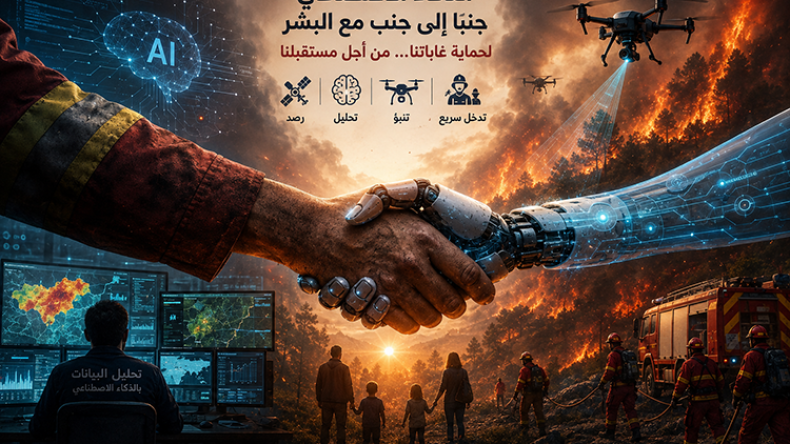
Algeria faces a recurring danger from forest fires, which cause loss of life, destroy property, and inflict environmental damage across the country. These destructive events pose a significant and persistent threat to both the natural environment and human settlements, necessitating strong and innovative countermeasures. In response to these persistent threats, the nation is noting the need for technology, particularly artificial intelligence, to serve as the primary 'warrior' in combating what it describes as hybrid wars, including such natural disasters. This forward-looking approach shows Algeria's commitment to developing a national system for disaster prevention and prediction through scientific innovation, aiming to safeguard its population and natural resources. The urgency of this issue was starkly demonstrated in August 2026, when forest fires led to tragic outcomes. A 25-year-old woman died in Jijel, and 36-year-old Samir Boutarnikh lost his home and 150 livestock in M'sila. These incidents highlight the direct impact of forest fires on communities and livelihoods, reinforcing the push for advanced technological solutions to mitigate future occurrences and protect vulnerable populations. The full strategy being developed seeks to integrate advanced technologies to enhance early detection, rapid response, and thorough investigation capabilities.
Innovations in Fire Detection
Researchers at the Center for Development of Advanced Technologies (CDTA) developed the first Algerian remote forest fire detector in 2023. This new system is designed to cover hundreds of square kilometers, offering a wide-area surveillance capability key for monitoring vast forested regions. The CDTA fire detector underwent testing in the wilayas of Medea and Ouargla, demonstrating its efficacy in diverse geographical conditions, with plans for its deployment in other regions across the country. Its technical specifications allow it to detect fires from a range of 10 km to 30 km away, providing a substantial lead time for intervention. This detection is achieved through the use of reflected waves and light beams, which then trigger immediate alerts to facilitate early intervention by response teams, thereby minimizing potential damage and loss.
In a broader strategic move, the National Forest Conservator and the Directorate General of Civil Protection are adopting a proactive approach for the 2026 campaign, scheduled from May 1 to November 30. This full strategy incorporates artificial intelligence (AI), 5G networks, and the Internet of Things (IoT) to enhance fire management capabilities across the nation. A key component of this technological integration is the utilization of 5G networks. These advanced networks are expected to enable strong and stable communication among ground teams, drones, and command centers, forming a strong and interconnected operational framework. This advancement aims to overcome traditional wireless communication issues often encountered in rugged or remote areas, thereby significantly improving coordination and response efficiency during critical fire incidents. The integration of IoT devices will further enhance data collection and real-time monitoring, providing a more granular understanding of fire dynamics and environmental conditions.
Robotics and Drone Capabilities
The Directorate General of Civil Protection has deployed 35 drones, which are equipped with high-definition thermal cameras and various sensors, and plans to acquire an additional 80 units to expand its aerial surveillance fleet. These drones are being utilized by Algeria to monitor forests and detect fires, operating continuously day and night with their high-definition and thermal imaging capabilities. The ability of these drones to operate around the clock, coupled with their advanced imaging, provides an invaluable tool for sustained surveillance, especially in areas difficult for human access or during low visibility conditions.
Khaled Bastea, a resident of Al-Qubba in Algiers, developed the first Algerian firefighting robot, named 'Ecozoom'. The Ecozoom robot represents a significant leap in automated firefighting technology, offering a safer and more efficient alternative to human intervention in high-risk zones. This innovative robot can be controlled remotely from a distance of up to 300 meters, allowing operators to remain at a safe remove from immediate danger. It is outfitted with a powerful water cannon capable of reaching 80 meters, enabling it to suppress fires effectively from a considerable range. Its strong design and operational capabilities mean that Ecozoom can replace the efforts of three to four civil protection officers, significantly reducing personnel risk and enhancing operational capacity. Ecozoom is powered by large capacity batteries, providing an impressive operational duration of six hours, ensuring prolonged deployment during critical firefighting operations. It integrates a thermal camera for enhanced detection, allowing it to identify heat sources and navigate through smoke-filled environments more effectively.
Mohamed Zakaria Hachlaf, a young researcher specializing in astronomy, space, and astrophysics, proposed the establishment of a security cell that would utilize satellite data for real-time fire monitoring. This proposal aims to leverage the vast observational capabilities of satellite technology to provide continuous and wide-area coverage of potential fire zones. Hachlaf also suggested the development of medium-sized firefighting drones as part of the country's strategic response, envisioning a multi-layered aerial response system that combines large-scale surveillance with targeted intervention capabilities.
AI for Prevention and Investigation
Students from Blida 1 University, Biskra University (2025), and Ghardaia University (2023) have contributed to the national effort by presenting graduation projects focused on utilizing artificial intelligence to combat forest fires. These academic contributions highlight the growing interest and expertise within Algeria's educational institutions in addressing national challenges through technological innovation. Mohamed Zakaria Hachlaf, the young researcher who also proposed the security cell, offered his assistance during the August fires, aiming to contribute to early detection and immediate response through AI. Hachlaf's proposal was significantly influenced by his 2021 training with NASA and a subsequent meeting with MAXAR, an American company renowned for its advanced space sensing systems, which provided him with valuable insights into advanced remote sensing and data analysis techniques.
Algeria's Alsat-A3 and AlsatB3 satellites are considered vital for remote sensing, providing accurate real-time information on climate conditions, fires, and their distribution across the country. These national satellite assets offer a key vantage point for monitoring large geographical areas and detecting nascent fires, complementing ground-based and drone surveillance. Dr. Khaled Hreizi, an expert in GIS and remote sensing, stated that digital and geographical platforms featuring forest paths connected to satellites and drone surveillance would have enabled a more effective fire response. Such integrated platforms would provide a full operational picture, allowing for better situational awareness and resource allocation. Digital prediction models, powered by AI, can identify villages and residential areas potentially in the path of fires, allowing for preemptive evacuation and optimizing the allocation of aerial resources like water bombers and helicopters. This predictive capability is vital for minimizing human casualties and property damage.
Most fires are attributed to deliberate acts, ignorance, or carelessness, making the identification of perpetrators challenging across vast forest areas. This difficulty shows the need for advanced investigative tools. AI algorithms can analyze drone footage within seconds, distinguishing actual smoke from fog or dust and precisely pinpointing fire origins with high accuracy. This capability significantly reduces the time and effort required for initial assessments and investigations. AI can analyze pre-fire scenes to identify suspicious activities, such as vehicles stopping in isolated areas or individuals entering forests before a fire starts, thereby assisting investigators in building cases and deterring future incidents. Citizens are also contributing to prevention and investigation efforts by filming perpetrators and sharing videos on social media, a process greatly facilitated by 5G technology, which helps security forces make swift arrests based on real-time evidence. This collaborative approach, combining advanced technology with public vigilance, strengthens the overall defense against arson.
Bridging Academia and Application
International consultant in digitalization and economic development, Abdelrahman Hadef, stated that universities are essential drivers of innovation and solution creation. Hadef emphasized the necessity of institutional capacity to transform student innovations into tangible realities, thereby bridging the key gap between academia and the economic and institutional environment. This transformation is critical for ensuring that academic research and development translate into practical, deployable solutions for national challenges.
A proposed five-stage practical work process for this transformation includes innovation discovery, where promising ideas are identified; potential assessment, which evaluates the feasibility and impact of these innovations; field testing through 'Living Labs', providing real-world environments for refinement; securing funding and public procurement, to finance and integrate successful projects; and finally, scaling up successful projects for widespread implementation. Public authorities could play a key role by establishing clear mechanisms to identify promising projects from universities and research centers. These mechanisms would then support projects through experimentation and further development, ensuring that academic advancements contribute directly and effectively to practical applications in fire prevention and response, ultimately strengthening Algeria's resilience against the recurring threat of forest fires. This systematic approach aims to cultivate a strong ecosystem where innovation is not only fostered but also successfully deployed to serve national interests.