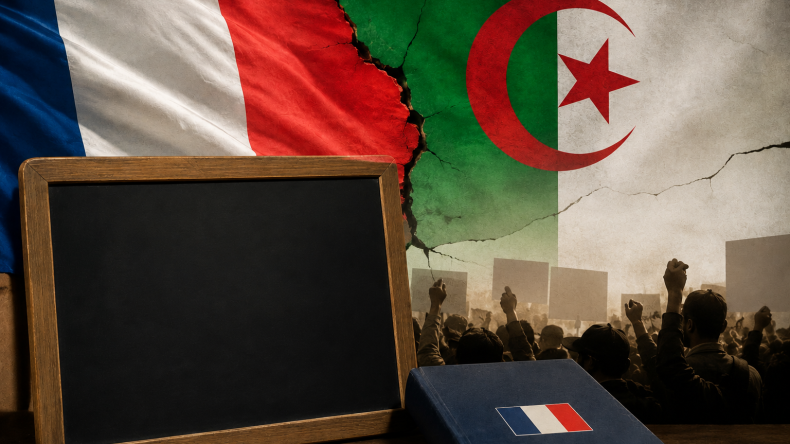
Amar Ingrachen, director of Franz Fanon Publishing House in Boumerdes, recently proposed recognizing French as a national and official language in Algeria. His suggestion appeared in an article published in the French weekly Marianne, sparking renewed discussion on the role of French within Algerian identity. Ingrachen's article argues that framing the rejection of Arabic's dominance as a prerequisite for openness and modernity reflects a colonial logic. This particular argument suggests that such a perspective inadvertently echoes a historical colonial mindset rather than fostering genuine progress. The proposition reignites long-standing debates in Algeria concerning linguistic identity and post-colonial ties with France, bringing to the forefront complex questions about national heritage and future direction.
Author and His Proposal
Amar Ingrachen, whose recent proposal has sparked considerable debate, previously authored an article in Marianne in May 2025 titled "Teaching the French language: Algeria settles its accounts with France, and sacrifices the language of 'the colonizer'." This earlier piece also delved into the intricate relationship between Algeria and its former colonial power through the lens of language education. Ingrachen earned his doctorate in French Literature and Civilization from the Sorbonne two years before the publication of his more recent article, providing him with an academic foundation in the subject matter. His publishing house, Franz Fanon Publishing House, based in Boumerdes, has been active in promoting diverse literary works. During the Gaza events, the publishing house promoted a book titled "Jewish Algeria," which featured a preface by a French-Israeli professor of Algerian origin, noting its engagement with multifaceted cultural narratives. The International Publishers Association recognized Ingrachen's work by nominating him as one of six finalists for the 2025 Voltaire Prize. This prestigious award acknowledges exceptional courage in defending freedom of publication, showing Ingrachen's commitment to intellectual discourse and literary freedom.
Critique of Linguistic Colonialism
Amar Ingrachen, whose proposal to recognize French as a national and official language in Algeria has generated widespread discussion, also voiced criticism of certain related arguments. In his article, Ingrachen challenged the notion that elevating French to an official language status would inherently resolve Algeria's challenges in education, science, economy, or unemployment. He suggested that such an expectation mischaracterizes the role of language in addressing these complex societal issues, implying that deeper structural problems require more than just linguistic adjustments. The author's critique points to a potential oversimplification of national development by attributing solutions to linguistic policy alone, rather than addressing the root causes of these challenges.
Franz Fanon Publishing House, founded 12 years ago by Ingrachen, has also experienced operational challenges during its existence. In 2025, the publishing house faced a legal penalty that resulted in its closure for a period of six months. This incident affected the operations of the Boumerdes-based publisher, known for its focus on Algerian and post-colonial literature. Despite these setbacks, the publishing house continues to contribute to the literary landscape, fostering discussions on identity, history, and culture within Algeria and beyond. The nomination of its director for the Voltaire Prize further attests to the significance of its work in promoting freedom of expression.
Algeria's Constitutional Language Choice
Algeria has constitutionally established its linguistic balance, with calls now focusing on developing the teaching of all languages, beginning with Arabic, and encouraging openness to English and other languages. This constitutional framework reflects a deliberate national choice regarding linguistic identity and priorities. The author of the article stated that French is an integral part of Algeria's modern history, acknowledging its undeniable presence and influence over centuries. However, the author argued that history does not singularly define constitutional identity, citing colonialism itself as an example of how historical events, while significant, do not encompass the entirety of a nation's constitutional framework or its contemporary identity. This perspective emphasizes that while historical ties are important, a nation's constitutional identity is a dynamic construct that evolves beyond its past, allowing for self-determination in linguistic and cultural policy. The ongoing debate surrounding French language status shows the complexities of forging a national identity in a post-colonial context, balancing historical legacies with contemporary aspirations and constitutional mandates.