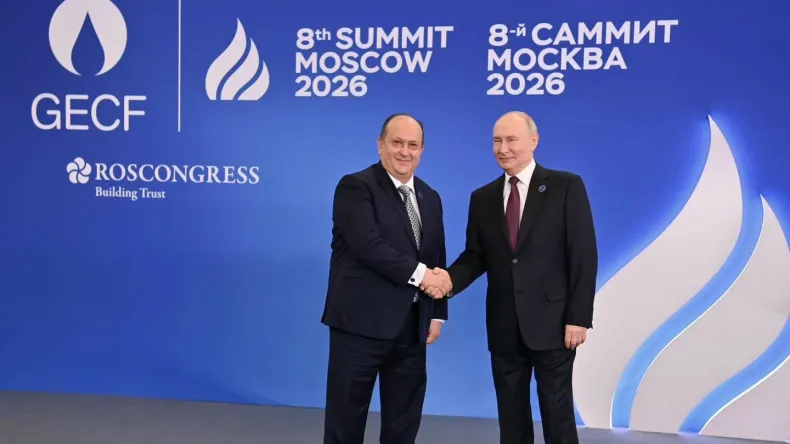
President Abdelmadjid Tebboune addressed the 8th Summit of the Gas Exporting Countries Forum in Moscow on 27 October 2026. He advocated for deeper collaboration among member states to protect global energy interests. "The current context requires consolidating the role of our forum and strengthening cooperation among its members to ensure market stability and security of supply in the face of geopolitical tensions," President Abdelmadjid Tebboune stated. He also addressed the regulatory environment surrounding the sector. "Energy policies are a sovereign right for every country, and volatile legislation fuels market instability, curbs investment, and puts security of supply at risk," he added. The summit brought together international representatives to discuss the future of gas exports and the stabilization of global markets.
The discussions in Moscow emphasized the critical importance of shared strategic objectives among gas-exporting nations. Member states reviewed the current state of international energy markets, focusing on the infrastructure requirements necessary to maintain consistent production levels. President Abdelmadjid Tebboune noted the necessity of unified action, noting that the Gas Exporting Countries Forum serves as a vital platform for dialogue between producers and consumers. The forum participants examined how to balance the immediate requirements of global energy security with the long-term sustainability of the industry.
Algeria's Historical Energy Role
Algeria established its position as a pioneer in the global gas industry by constructing the world's first natural gas liquefaction plant in Arzew in 1964. This facility marked the beginning of large-scale international gas trade infrastructure for the nation. Algeria has been a pioneer in the gas industry since building the world's first natural gas liquefaction plant in Arzew in 1964. This foundational project allowed the nation to develop the necessary expertise to become a key player in the international energy market.
Current data confirms Algeria remains among the top ten global gas producers. The country also functions as the second-largest supplier of natural gas to the European Union, delivering fuel through an extensive network of pipelines. Algeria is currently among the top ten global gas producers and the second-largest supplier to the European Union via pipelines. This established supply route shows the reliance of international markets on Algerian natural gas production.
Future infrastructure projects aim to expand this export reach further. The proposed Trans-Saharan Gas Pipeline represents a major development in this strategy, with a planned export capacity of 30 billion cubic meters per year. The proposed Trans-Saharan Gas Pipeline has a planned export capacity of 30 billion cubic meters per year. This pipeline project is viewed as a significant enhancement to existing export capabilities, facilitating the transport of gas to global markets.
Energy diversification efforts are also underway alongside traditional gas exports. Algeria maintains a national program to produce 15,000 megawatts of renewable energy by 2035. The government has allocated an investment of 22 billion euros to reach this renewable power generation goal. Algeria has a national program to produce 15,000 megawatts of renewable energy with an investment of 22 billion euros by 2035. This initiative represents a strategic shift toward integrating sustainable energy sources into the national grid while maintaining the country's status as a primary exporter of traditional energy commodities. The investment allocation reflects the government's commitment to achieving these specific renewable energy targets within the established timeframe.